
This article was originally written for The Guardian, here.
The New York Police Department is on trial in Floyd v City of New York, and the public is watching.
It is ironic that the policy of recording “stops, questions, and frisks” originated with the 1999 police shooting of Amadou Diallo (and subsequent acquittals), and the 1997 torture of Abner Louima in a Brooklyn police station. The US Civil Rights Commission intervened, and data have since been collected on the UF-250 forms. Over a decade later, vigils and protests in response to the police shootings of RaMarley Graham, 18, last year, and, just last week, Kimani Gray, 16, pose tough questions about whether progress is being made in police-community relations.
Three 2012 cases, regarding the Open Container law, marijuana arrests, and suspicion based on a “hunch”, indicate that the NYPD‘s approach to the fourth amendment is coming under close scrutiny. Justice Shira Scheindin has also hinted in Floyd pre-trial proceedings that “high crime area” and “furtive movements” could be coming under fire: these key phrases have become vague standards for police to justify “probable cause” to search.
The scale of the “stop-and-frisk” problem
Class action civil rights cases allow us to look at data on a systemic level. A class action suit is the affordable option for NYC taxpayers and the court. If each plaintiff were to bring a harassment lawsuit against the NYPD under civil rights provisions of Section 1983, it would crash the system.
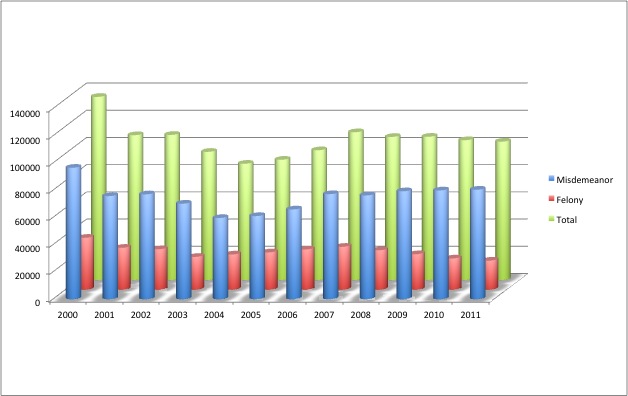
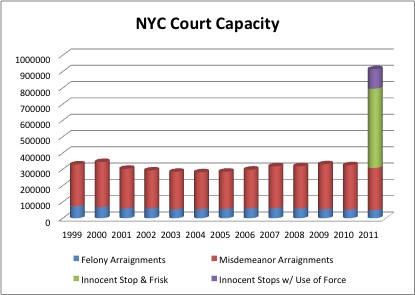
Over the past decade, NYC has arraigned roughly 300,000 stop-and-frisk cases per year (pdf). If individual cases were to begin flooding the court calendar, the calendar would triple in size overnight. In 2011, the NYPD self-reported 119,163 “uses of force” where there was neither arrest nor summons issued; furthermore, they frisked 324,700 people and issued no form of citation.
Some young females have complained that their frisks amount to groping. Whether minor or severe, the “frisking” cases exceed the number of misdemeanors in the courts.
Speaking Monday, as Floyd got underway, New York Mayor Michael Bloomberg defended the NYPD and the stop-and-frisk policy:
“This past week, with a city of 8.4 million people, we had one murder. I can’t imagine any rational person saying that the techniques are not working and that we should stop them. We believe we do it consistent with the law in terms of having reasonable cause … We don’t look at anybody’s ethnicity. We go where the crimes are.”
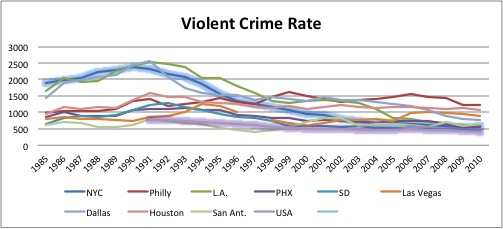
But murder rates – though a commonly used indicator of overall crime – are also a salacious, inaccurate, and often misleading metric. Homicides represent less than 1% of crimes. With such a small sample, a murder rate can fluctuate with every single incident.
Murders are misleadingly used as a leading indicator of public safety. But any study on “safety” would always have an element of subjectivity. What is “safe”? It is a feeling, not a fact. It is relative, and highly impacted by the media’s reporting of crimes, both near and far. In New York City, the numbers and the rhetoric don’t always match up.
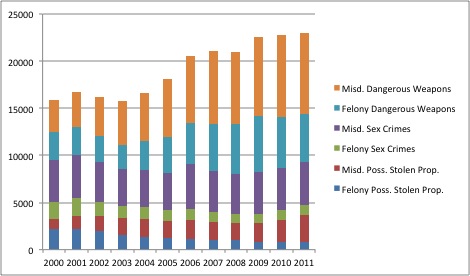
Data are manipulated: criminologist and former NYPD Captain John Eterno has explained how this manipulation is systemic. The New York Times made a study of 2,000 former police officials and found the same. Perhaps a sign of the manipulation is that some felonies (drugs, sex crimes, stolen property) have gone down, while their misdemeanor counterparts have risen.
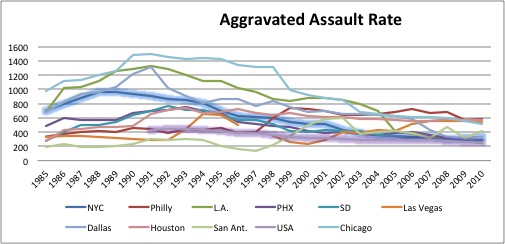
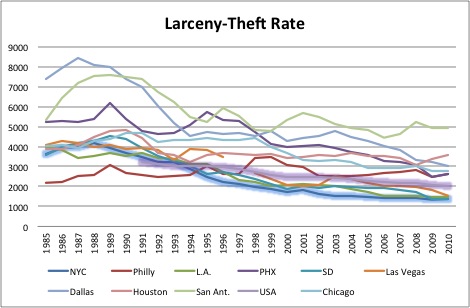
When looking at all the NYPD data, in the round, there are many indicators showing crime has risen in NYC.
Safer with stop-and-risk? How precincts match up
And what about the mayor’s claim that “we don’t look at anybody’s ethnicity”? When comparing the ten New York police precincts with the lowest percentage of black and Latino residents with the ten precincts with the highest percentage of black and Latino residents, the numbers are startling. Residents in largely white neighborhoods are being stopped on average at a rate of 4%, and crime in those precincts is falling by 42%. In communities of color, the frequency of stops is at 16%; while crime is dropping 22%. In other words, four times the hassle, for half the results.
But the true picture is worse than that. Thousands of residents in the financial district and Tribeca, for example, hardly represent the millions of people subjected to possible stops in that district. If police actually stopped 5% of all the people who travel through the tip of Manhattan, it would outnumber the residents of that precinct. Meanwhile, residents in districts like Hunts Point in the Bronx bear the entire brunt of the police activity, since tourists and workers aren’t flooding the precinct.
The fiscal cost of stop-and-frisk
A number of sources have shared their recordings of stops, including copwatch organizations such as All Things Harlem. It is clear that there is a wide chasm between the real stops and the NYPD’s textbook example. Even on the most conservative estimates, we can see the level of resources expended to continue this policy, which is directed primarily at black and Latino young men and boys.
The annual 685,724 stops require over 80,000 hours to complete. This works out at over 229 hours per day spent stopping, questioning, and frisking the city’s residents. Officers earn over $22 per hour after six months, and so taxpayers dole out well over $11 per stop, the vast majority of which will not yield a summons or arrest and are rarely connected to looking for a particular suspect.
This $7.5m conservative estimate is nothing, though, when compared to the $135m the NYPD has cost the taxpayers (pdf) in litigation costs relating to stop-and-frisk lawsuits. This amount will likely continue to spiral upwards, considering just the recent highly publicized cases. In the case of Kimani Gray, it has been reported that the two police officers involved in the shooting of the Brooklyn teenager have racked up $215,000 in litigation settlements over civil rights violations. The spike in civil rights and police action claims in recent years suggests a deteriorating relationship with their communities.
Creating safe communities or fostering suspicion and division?
Even if we set racial targeting and constitutional protections aside, the ultimate social questions are whether it is acceptable for nine innocent people to be harassed for every one person caught engaging in some form of misconduct; further, whether it is acceptable for 20 innocent people to be harassed for every one person caught doing something reasonably serious; and finally, is it acceptable for 90 innocent people to be harassed for every one person caught doing something actually dangerous?
The answer to these questions may be “yes” for some people. But it is an answer that should apply to one’s own community, and not be imposed on others’. For example, would supporters of stop-and-frisk feel the same way if college dorms were targeted … especially if the “hit rate” for criminality were higher? The current state of affairs appears to many as a massive campaign designed to erode stability in communities of color: distrust, despair, and hate then compound the dilemma of labeling young men with criminal records. Families lose income, children lose parents, and low-income New Yorkers lose the right to live in public housing. One person’s plight provides little insight; we need to look at the policy’s collective impact upon millions.
The Floyd case has allowed some long-excluded voices to finally be heard, but are the police listening? Considering one of the shooters of Amadou Diallo has been working with a badge but no gun ever since, earning over $1m from the NYPD, it is challenging for urban residents to feel protected and served. To know you are a “suspect” for simply walking down the street, the feeling is closer to being under occupation.
Related articles
- Crashing the System with Stop and Frisk (unprison.com)
- What They Don’t Tell You About NYC Crime Data (unprison.com)





 unprison
Is Racism Really This Blind?
U.S. trademark law says that there is no commercial protection for a disparaging term or symbol. In 1992, the Trademark Trial and Appeal Board agreed that “Redskins” may disparage people, living or dead, or bring them into contempt or disrepute. Since then, schools across the country such as St. John’s and Tallequa changed names away from Native American epithets like the “Redmen.” The NFL team, however, had this decision reversed after the court ruled that these plaintiffs waited too long after they turned 18, the age of majority.
The issue is back, and this time the plaintiffs are teenagers. The nonchalant treatment of this story makes me think of how quickly people are to dismiss or overlook racism. From the comfort of one’s home, they utter things like the injustices caused Native Americans are long passed, and there is nothing I can do about it now. While they root for RG III and the resurgent Washington Redskins on Sunday afternoon. While the poverty level, and resources, on Reservations is abysmal. While lawsuits over mineral rights continue in the courts.
Is there a dispute that the term “Redskin” is a racial epithet? There is no indication it ever became anything other than such. All the Super Bowls and all the Quentin Tarrantino films will never turn a slur into an acceptable label, no matter how common the usage. People aren’t out on the Rez saying, “Yo, what up Redskin?” Nobody of Native American heritage ever introduced themselves as a Redskin.
In 1971, the Golden State Warriors eliminated Native American imagery from their nickname and in 1989 the Kansas City Chiefs stopped with the Indian-on-a-Horse gimmick. The 1992 Super Bowl in Minneapolis, a city with one of the largest Native American populations, included a protest about the football team from D.C. who went on to win the game.
If the Washington, D.C. football team wishes to honor people of local history, perhaps they can find a word for the slave labor that built much of the District, including the Capitol and Supreme Court. But as the judge in the current trademark case said, the team can call themselves the Washington N-word with nothing but honorable intentions and still be subject to scrutiny. The fact that the “Redskins” are in our nation’s capital makes it all the more offensive, whereas the near-genocide of this continent’s original people should be a wrong that deserves righting, not ridicule.
Even Southern nicknames, like the Runnin’ Rebels, can make a case for honoring the people who fought for their land, regardless of how pure their motives. We don’t see the Tennessee “Damn Yankees” or the Massachusetts “Klansmen.” UMass, incidentally, are the “Minutemen.” Similarly, the New England “Patriots” use an honorable word as pride in local history. Nobody is called the “Tories,” in honor of those who supported the British.
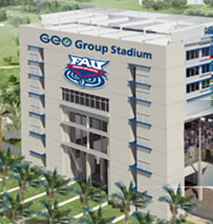
It seems to me that the most distinct Native American nickname, the U. of North Dakota Fighting Sioux, is arguably cast in an honorable light. Although some Native Sioux supported the name, the state’s voters overwhelmingly decided to drop it in 2012. This is after the NCAA began sanctioning the school, and there were repercussions looming from their conference. Might a similar fate be in store for Florida Atlantic Owls, after selling their stadium naming rights to a for-profit prison corporation? The stadium is already labeled “Owlcatraz.” (Pretty witty, you must admit.)
North Dakota responded to action taken in 2005 by the NCAA to attempt an eradication of names it considers hostile or abusive. The list included the Braves, Fighting Illini, Seminoles, Chippewas, Utes, and Indians. Interestingly, none of these terms are as disparaging as “Redskins,” and the NCAA chose to exempt North Carolina-Pembroke because, historically, 20% of their students are Native Americans. Central Michigan’s team was removed from the list after the Saginaw Chippewa Tribal Nation gave its support, as did the Seminoles, Utes, and Choctaws.
Ironically, Oklahoma is most populous of Native Americans, their teams are named after Sooners (who came to get the “free” land “liberated” from Native ownership) and Cowboys- not the Indians. Southeastern Oklahoma State was the “Savages,” but changed to the “Savage Storm.” Washington, D.C.’s connection to Indians: Broken Treaties and the War Department that ordered continual confrontations and building a series of military outposts to expand West and South. There is no tribe that can give its blessing to “Redskins.”
There are no nicknames like the “Blackies,” “Yellowmen,” or “Crackers.” And there should not be. Would the “Berlin Kikes” be okay in another 100 years? No. Claiming ownership of another culture’s symbols, and then to say it is honoring them despite their protests against this “honor,” is racism. War paint is like back-face. Foam tomahawks and spears, along with beers, is denigration.
An amicus brief by the NFL Players Association, supporting the trademark cancellation, would not be out of the question.
Unlike the Vikings and the Spartans, Native Americans are living with us among the diverse fabric of our nation. People have a right to decide how they will be characterized and not be rendered into caricatures. If a corporation arguably has a right to trademark someone else’s cultural symbols (which I am not certain they do), the Lanham Act certainly outlaws such names and symbols that are disrespectful.
Related articles
Share this: