

I like to believe that more Americans believe in the concept of equal justice today than in 1963. The 50th Anniversary of the March on Washington will evoke different thoughts from different people, some with nostalgia, others with disdain. My point isn’t to take a historical narrative, as others can provide that quite well. What is important for America to realize today is that the struggle for equal civil and human rights continues in 2013.
A new video, “Our Turn to Dream,” expertly explains the current situation of low-income people, particularly Black and Latino Americans, facing what can only be considered a police state. Pastor Kenny Glasgow, founder of The Ordinary People Society (T.O.P.S.), started working towards rebuilding his own community in Dothan, Alabama; but then realized that this issue looks the same nationwide.
Here are a few myths that need to be debunked:
- The American system of mass incarceration, which addresses the effects of poverty, unemployment, mental illness, and addiction by using prison cells. We cage those of us who fall by the wayside or get caught up with a youthful indiscretion or a moment of uncontrolled emotion. It is a myth that over-incarceration is some sort of mistake. The flaws and results are not a mistake. Anything of this magnitude is not a mistake. Thus, we can’t just educate American politicians and believe that the mistake will be corrected.
- Racism is over. Oh, that’s the myth. Most people will acknowledge that racism is a cultural phenomenon dating back hundreds, even thousands, of years. They will acknowledge that slavery could not have worked without the skin color; that Manifest Destiny (i.e. seizing all the land from sea to sea) would not have worked without designating the residents as “savages.” Yet we don’t want to believe racism is still at play in 2013. It was all the way up to 1963, but it disappeared as soon as President Johnson signed the Civil Rights Act.
People ask me “how can you say the criminal justice system is racist, that’s just hyperbole.” I don’t want that person to catch a sound-byte and move on, believing or disbelieving. I want them to ask for an explanation. There are dots to connect regarding power and economics. So check this out:
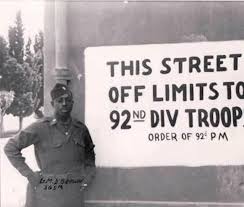 Prison as System to Control ALL Americans
Wars have always been fought for multiple reasons. There is generally some resources to seize, or strategic position to gain, but they also unite citizens against a common “other” enemy. Wars also create profits for those who build the war machinery, and employ soldiers at low wages based on the ideology of “defending their country.”
Wars, and their residual effects, don’t always go so smoothly. Black soldiers returned from WWII with a sense of entitlement and opportunity. The G.I. Bill and the Civil Rights Movement vastly expanded a middle-class, right in the face of those who freely used the N-word. Twenty years later, the Vietnam War took a very bad turn. The war militarized young Black men, some of whom had a similar sense of entitlement and opportunity. Meanwhile, President Nixon and J. Edgar Hoover infamously waged a covert domestic war against people struggling for equality here in America.
The “War on Drugs” was launched in 1972. It was direct replacement of the Vietnam War. This time the enemy wasn’t fascism or communism and we didn’t need to draft anyone or violate a sovereign nation to fight it. The enemy lived in low-income urban communities, the same places these Black and Latino young men returned to after service in Vietnam. Many had the physical, mental, and spiritual challenges of surviving war- and were now looking for jobs.
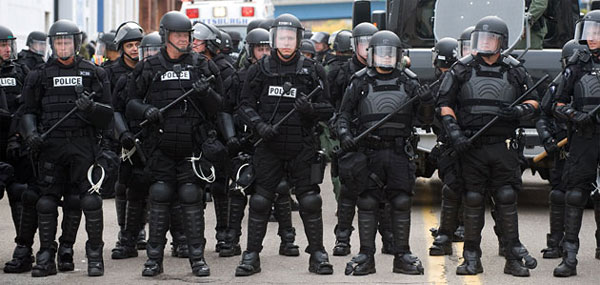 City police forces began bulking up as federal dollars started to roll. The cultural campaign of describing drugs as an evil scourge started to bloom. And who would say our leaders are wrong? The Civil Rights Movement had been appeased, infiltrated, arrested, and assassinated. Peaceful assembly, free speech, and petitioning the government became scary. Some of the survivors blinked, or looked the other way, or (most likely) never really saw it coming. The master-stroke of the drug war was in full swing before long.
The drug war is genius. It is bipartisan. Industrial magnate Jay Gould once bragged that he could “pay half the working class to kill the other half.” In the drug war, half the working class is paid to incarcerate the other half. There are White prisoners and Black guards, yes. But those exceptions do not stunt the fact that skin color is an essential element of the cultural messaging of the drug war.
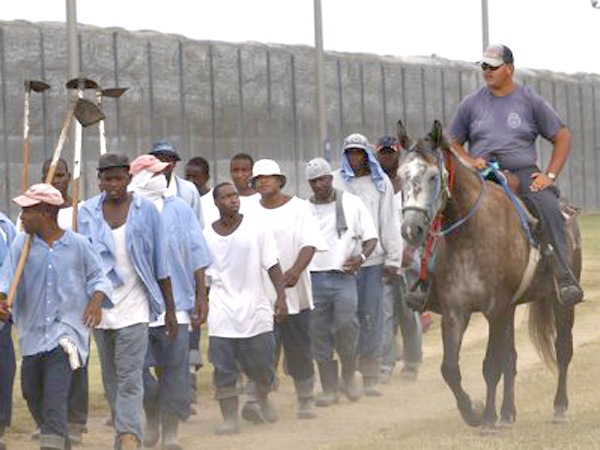 Mass Incarceration Evaporates Without Racism
It is understandable, if one believes drug users and drug sellers to be such an evil scourge, that we send police into the most concentrated areas of drug use. Particularly if these perpetrators are young people; the younger we get them the longer we can punish them without paying for their geriatric care in prison. And the earlier we can get these people off the streets. Now imagine this group of concentrated drug users…
What did you imagine? If you are seeing young Black men hanging out on a basketball court you are wrong. The most concentrated area of drug use is in college dorms, frat houses, and similar apartments in such neighborhoods.
 Oh, but young White people are just going through an “experimental” phase. I’ve never heard such a description of drug use by young Black and Latino people. As someone who has been among drug users and sellers of both communities, I can tell you there are experimenters, steady users, and people who need help everywhere. But you knew that. The gut reaction is due to 40 years of cultural messaging by those in power. Thank the 11 o’clock news, while you’re at it.
Serving Multiple Masters- Excess Labor
 Its not like America’s best economic minds have a better idea. In our state-subsidized economic system (call it Capitalist, Socialist, or whatever), the tax-payer is the top customer and top employer, whether directly or indirectly. Without manufacturing jobs, where do we send the labor? One super-crane eliminates 100 dockworkers. Even the checkout girl has been replaced with a machine.
Police, guards, and sheriffs require little training and education to be on the job. Their existence has also massively expanded the jobs for judges and lawyers. Furthermore, the incarcerated and formerly incarcerated are not counted amongst the “unemployed.” They (or “we,” I should say) are written off as non-existent. More importantly, we are not allowed to come home with a sense of entitlement and opportunity. Even if some of us did, we are sometimes traumatized by our experience with no outlets through which to heal.
And Yet It Crumbles…
The Law of Diminishing Returns is the principle where something only works to a certain extent. If you keep doing more of it, the thing starts getting worse. Put two cooks in the kitchen and make twice the food. Put four cooks in the kitchen and you start getting half the food.
The American governments can’t literally pay half the working class to lock up the other half. Just like telecommunications have made it difficult to wage war against the “savage” foreigner, it is difficult to maintain the rhetoric that drugs are evil, a moral curse, or that children who commit crimes expose their inner evil, or that formerly incarcerated people are incapable of raising children and being good neighbors.
Fifty years after the March on Washington and some reports indicate we are more segregated than ever, with a greater class disparity than any country except India. Yet all the private schools and gated communities cannot keep the tides of change at bay. Tens of millions of Americans have been put in cages. Each is part of a family and circle of friends. With over 65 million Americans having a criminal record, and likely over 100 million people directly impacted by an over-criminalizing, super-sentencing criminal justice system costing billions of dollars every year… it is tough to keep the lie alive. The lie is that this is all for your own good.
When the cure becomes worse than the disease, you have lost the confidence of your patient. Americans want to redesign the solutions and reallocate the billions of dollars. A movement is in place. We can call it a Civil Rights Movement, a Formerly Incarcerated and Convicted People’s Movement, or anything else. When the incarcerator begins expanding their industry to probation, parole, electronic monitoring, rehabilitation, and halfway houses: its because the rhetoric of cages has fallen on deaf ears and empty pockets.













 unprison
The Myth of Prison Slave Labor Camps in the U.S.
Prison dorm, Leavenworth, Kansas (Photo credit: Wikipedia)
A Displaced and Discarded Labor Force, originally appearing in Counterpunch,
As Adam Gopkin reminds us, “mass incarceration on a scale almost unexampled in human history is a fundamental fact of our country today—perhaps the fundamental fact, as slavery was the fundamental fact of 1850.” The racialization of this process, popularized by author Michelle Alexander as The New Jim Crow, has meant that African Americans in the U.S. now have more than triple the incarceration rate of Blacks in South Africa at the peak of apartheid.
In the haste to impart some rationality to all this, many activists and analysts have been quick to point to corporations as the sole culprits behind the prison-industrial- complex (PIC). An important component of this perspective is the notion of prisons as “slave labor camps”. In this scenario a sea of multinational corporations super-exploit hundreds of thousands of contract prison laborers to heartlessly augment their bottom lines. Late last year researchers Steven Fraser and Joshua Freeman took up this point in a study which they presented in a CounterPunch article, arguing that “penitentiaries have become a niche market for such work. The privatization of prisons in recent years has meant the creation of a small army of workers too coerced and right-less to complain.”
Their perspective has resonated with a number of news services, anti-mass incarceration blogsters and activists. For example, a recent report from Russian news service RT claimed that prisons are “becoming America’s own Chinese style manufacturing line”. Huffington Post picked up the story, quoting Fraser and Freeman:
The HuffPost went on to name Chevron, Bank of America, AT&T, Starbucks and Walmart as major participants in what they called a “competitive spiral” to capture prison labor at the lowest possible wage levels. Vicky Pelaez, writing for Global Research earlier this year called prison industry a “new form of slavery” identifying more than twenty corporations involved in contract arrangements. Her list included IBM, Pierre Cardin, Target and Hewlett Packard. She concluded that, “thanks to prison labor, the United States is once again an attractive location for investment in work that was designed for Third World labor markets.”
As appealing as these scenarios are to our sense of moral outrage and the role of multinational corporations as the villains of our era, such assertions about prison labor are off the mark. I spent six and a half years in Federal and state prisons at high, medium and low security levels. In all these institutions, very few people, if any, were under contract to private corporations. My memories of prison yards feature hundreds and hundreds of men trying to pump some meaning into their life with exercise routines, academic study, compulsive sports betting, religious devotion, and a number of creative and entrepreneurial “hustles.” But being under the thumb of Bill Gates or entering a Nike sweatshop was just about the farthest thing from our warehoused reality.
Statistics bear my memories out. Virtually all private sector prison labor is regulated under the Prison Industries Enhancement Certification Program (PIECP). Any prison wanting to publicly markets goods worth more than $10,000 must register with PIECP. The PIECP statistical report for the first quarter of 2012 showed 4,675 incarcerated people employed in prison or jail PIECP programs, a miniscule portion of the nation’s more than two million behind bars.
Likely the largest single user of contract prison labor is Federal Prison Industries, which handles such arrangements for the Bureau of Prisons (BOP). Of the nearly 220,000 people housed in BOP facilities, just 13,369, representing approximately 8% of the work eligible “inmates” were employed as of September 30, 2012. However, the overwhelming majority of this production was for government departments like Defense and Homeland Security, rather than private corporations.
There is an economic rationality to why prison labor is so infrequently used. While incarcerated people may constitute a captive workforce, in the era of mass incarceration security trumps all other institutional needs, including production deadlines. A fight on the yard, a surprise cell search, even a missing tool can occasion a lockdown where all activities, including work assignments come to a halt for hour, days, or, in some cases even weeks or months. Multinational corporations accustomed to just in time production systems and flexible working hours don’t respond well to this type of rigidity.
Portraying our prisons as slave labor camps satisfies a certain emotional appeal, but hunting down multinationals that are extracting superprofits from the incarcerated diverts us from the crucial labor issues at the heart of mass incarceration. Those behind bars constitute a displaced and discarded labor force, marginalized from mainstream employment on the streets by deindustrialization in their communities and the gutting of urban education in poor communities of color. More than half of all Black men without a high-school diploma will go to prison at some time in their lives. The school to prison pipeline is far more of a reality than slave labor camps.
Plus, the shift of the prison system’s emphasis from rehabilitation to punishment in the last three decades has blocked opportunities for people to upgrade skills and education while incarcerated. As the nuns used to tell me in grade school: “an idle mind is the devil’s workshop and idle hands are the devil’s tools.” The brains behind our prison system clearly had the devil’s welfare in mind when they reoriented our institutions away from rehabilitation into warehousing millions of people while stripping away their opportunities for personal and collective development. As a result purposelessness and excruciating boredom, not overwork, are the dominant features of most prison yards.
For those trying to put an end to mass incarceration, framing the labor issues of the prison industrial complex in this way takes us down a very different road than upgrading the conditions of the minute numbers behind bars who are under corporate contracts (or as some unions are want to do-portraying prison laborers as scabs who undermine hard won working class gains). The chief labor concerns about mass incarceration are linked to broader inequalities in the economy as a whole, particularly the lack of employment for poor youth of color and the proliferation of low wage jobs with no benefits. Employment creation and the restoration of much needed state provided social services like substance abuse or mental health treatment are the measures that will keep people on the streets. Forget about minimum wages for the mythical millions working for Microsoft in Leavenworth and Attica.
But the labor aspect of mass incarceration doesn’t end there. People with a felony conviction carry a stigma, a brand often accompanied by exclusion from the labor market. Michelle Alexander calls “felon” the new “N” word. Indeed in the job world, those of us with felony convictions face a number of unique barriers. The most well-known is “the box”-that question on employment applications which asks about criminal background. Eleven states and more than 40 cities and counties have outlawed the box on employment applications. Supporters of “ban the box” argue that questions about previous convictions amount to a form of racial discrimination since such a disproportionate number of those with felony convictions are African-American and Latino. Advancing these Ban the Box campaigns will have a far more important impact on incarcerated people as workers than pressing for higher wages for those under contract to big companies inside.
However, even without the box, the rights of the formerly incarcerated in the labor market remain heavily restricted. Many professions, trades and service occupations which require certification, bar or limit the accreditation of people with felony convictions. For example, a study by the Mayor of Chicago’s office found that of 98 Illinois state statutes regarding professional licensing, 57 contained restrictions for applicants with a criminal history, impacting over 65 professions and occupations. In some instances, even people applying for licenses to become barbers or cosmetologists face legal impediments.
Those with felony convictions face further hurdles when trying to access state assistance to tide them over during times of unemployment. In most states, those with drug convictions are banned from access to SNAP (food stamps) for life. Many local public housing authorities bar people with felony convictions even if their parents or partners already reside there.
Lastly, the very conditions of parole often create obstacles to employment. Many states require that an employer of a person on parole agree that the workplace premises can be searched at any time without prior warning-hardly an attractive proposition for any business. In addition, tens of thousands of people on parole are subject to house arrest with electronic monitors. All movement outside the house must be pre-approved by their parole agent. This makes changes in work schedule or jobs that involve travel an enormous challenge. Some basic changes to the conditions of parole could constitute an important step to easing the labor market conditions for people coming home from prison trying to secure and keep a job.
All of this is not to deny that many corporations have made huge amounts of money from mass incarceration. Firms like Arizona’s Kitchell Construction, which has built more than 40 state prisons and 30 adult jails have made millions. The Tennessee-based Bob Barker Enterprises is a “household” name among the incarcerated. With a corporate vision of “transforming criminal justice by honoring God in all we do,“ Barker has reaped massive profits from producing the poorest quality consumer goods, including two inch toothbrushes, for people behind bars. Then, of course, we have private prison operators like CCA and the GEO Group. Although the privates control only 8% of prison beds nationally these two firms managed to bring in over 3 billion in revenue last year.
While such profiteering continues, the prison-industrial complex remains driven by an agenda that is more about politics than profits. State-owned prisons and political agendas continue to lie at the center of mass incarceration. The combined revenue of CCA and the GEO Group for 2012 was less than half of the California state corrections budget. Politicians, with important influence from pro-corporate organizations like the American Legislative Exchange Council (ALEC), have made the PIC possible by passing harsh sentencing laws, funding the War on Drugs, tightening immigration legislation, and creating isolation units like Pelican Bay, Corcoran, Tamms and Angola. They have built a base of popular support for the “colorblind” approach of “lock ‘em up and throw away the key.” So while we need to curb the opportunities for corporate profit from putting people in cages, the main target of any campaign against the PIC must be to counter the racist ideology of “punitive populism” and reverse the political processes which perpetuate mass incarceration and the criminalization of the poor.
James Kilgore is a research scholar at the Center for African Studies at the University of Illinois (Urbana-Champaign). He writes on issues of mass incarceration with a focus on electronic monitoring and labor. He is also the author of three novels, all of which he drafted during his six and a half years in prison, 2002-09. He can be contacted atwaazn1@gmail.com
Share this: