
New Orleans to Re-Write Policy on Housing and Criminal Convictions

After months of pushing the Housing Authority of New Orleans (HANO) regarding a specific change in their Admissions and Evictions policies, a public hearing is scheduled for tomorrow night (Tues. 1/22/13), at HANO, 4100 Touro Street.  This effort was spearheaded by grassroots community members of two organizations, Stand With Dignity and Voice of the Ex-Offender (VOTE).  SWD has authored a Sign On letter expected to generate significant support among the social justice community, and VOTE’s written testimony pushes HANO uphold their mission to help all families, in accordance with civil rights law.  Community members are encouraged to testify.

On January 5th, 2013, HANO issued a draft “Criminal Background Policy Statement,” and notice for a public hearing.  A preamble to the statement references a Washington Post article that outlines the ignored plight of black males in America.[1]  HANO recognizes the lifelong label of “felon” is “an almost automatic bar to gainful work” and a “likely bar to admission to most affordable housing.”[2]

“HANO recognizes that, whether explicit or implicit, its practices have served to perpetuate the problem.  As the city’s major provider of affordable housing and of safe and healthy communities, HANO accepts that it has a responsibility to give men and women with criminal histories the opportunity to rejoin their families and communities and to rejoin them as productive members.”[3]

This represents a major shift in policy, recognizing the problem and the agency’s role in perpetuating discrimination and unstable communities.  The proposed Policy Statement, however, remains problematic.[4]

hud-website-photo-2HANO’s Proposed Policy Statement | 2013

Although lacking in specifics, the statement outlines key points:

  • All individuals, regardless of criminal history shall have equal access to employment and housing at HANO[5]
  • Automatic Bars to HANO:
    1. Pose a clear and present danger to community in which they might live;
    2. Criminal history includes acts of child abuse or sexual predation;
    3. History of domestic violence.

Reviewing “clear and present danger”:

  • Panel will evaluate all factors presented
  • Decision based on propensity for continued disruptive/criminal behavior, or probability or favorable future conduct.

This vague policy, in practice, may serve to broaden the pool of admissions denials and convictions, depending on:

(1) How “clear and present danger” is defined;

(2) How broadly they determine the scope of sex crimes;[6]

(3) What is meant by “history of domestic violence;”

(4) The composition of the review panel, and

(5) What guidance is used to analyze the factors.

HANO may ultimately bar people who were convicted of misdemeanors or who merely had the police respond to an alleged domestic violence scenario.  The detailed policy, if one is forthcoming, is yet to be written.  It remains to be seen what impact public pressure will have to alleviate draconian restrictions.

National Efforts to Amend Exclusion Policy

New-Orleans-home-demolition-sign-Housing-is-a-Human-Right1Courts and agencies have been asymmetrically moving in the same direction undertaken by New Orleans.  In Chicago, for instance, the state appeals court held that arrests, alone, are incapable of constituting a “history of criminal activity” and was not evidence that someone is a potential threat to the health, safety, and welfare of the public housing community.[7]  Despite all the arrests ending in dismissals, this man was barred from housing.

Reports on homelessness are also taking in to account criminal records, such as a 2003 survey finding 1 in 8 homeless adults in Minnesota had been released from prison within the past two years.[8]  A report on Illinois’ public housing identified four key areas for reform:

(1) The number of years to look back for past criminal activity;

(2) The use of arrests without convictions as proof of criminal activity;

(3) Use of vague categories neither applicants nor administrators can fully understand and apply fairly; and

(4) Absence of mitigating circumstances as a means to overcome barriers.[9]

The recent developments from HUD indicate a possibility that sustained efforts (including litigation, organizing, journalism, and studies) may propel a new set of national standards.  HUD first publicly dispelled the myths regarding barriers to public housing,[10] then reiterated this in a letter to all PHA executive directors- along with the stated commitment to helping ex-offenders gain access to housing.[11]

It is more accurate to perceive the arc of HUD as a natural arc of the War on Drugs than of political party preferences.  The agency has at times been trying to dismantle the PHAs’ discretionary exclusion regimes through HUD guidance, including admonitions that screening applicants is very difficult where criminal histories are mixed or marginal.[12]  HUD guidance calls for trained staff to sometimes gather additional information and intervention by outside agencies.[13]  Instead, HUD has watched the develop of blanket bans several decades in the making.[14]

HUD recognizes the look-back periods PHAs use are at times draconian, failing to take in account the principle of completing one’s punishment.  They have recommended that the term “recently” be defined as the past month or six months,[15] and discourage excluding former drug users and alcohol abusers, particularly where rental histories show a propensity for compliance.[16]  They have also advised PHAs to make case-by-case reviews, focusing on concrete evidence of seriousness, recentness of criminal activity, and evidence of rehabilitation, as best predictors of tenant suitability.[17]

Contemplate and Create the Dream.

Contemplate and Create the Dream.


[1] Gerson, Michael (uncited), “mid-December 2012,” Washington Post.

[2] DRAFT HANO Criminal Background Policy Statement, 1/05/13, at 1.

[3] Id.

[4] Id., at 2.

[5] HANO’s policy statement includes reference to employment which mirror housing eligibility,  This poses another problem, although it will not be addressed here.

[6] Currently, all people on the Sex Registry (regardless of level) are barred- including their families.  This is similar to Chicago.  See, e.g., CHICAGO HOUSING AUTHORITY, FY2010 ADMISSIONS AND CONTINUED OCCUPANCY POLICY, 14 (approved Sept. 21, 2010) (denying admission to applicants who have ―ever been convicted of a crime that requires them to be registered under a state sex offender registration program including the ten-year Illinois State Sex Offender Registration Act‖).

[7] Landers v. Chicago Housing Authority, 936 N.E.2d 735, at 742 (Ill. App. Ct. 2010).

[8] Wilder Research, Ex-Offenders Among the Homeless: Highlights From The 2003 Minnesota Survey of Homelessness 1 (June 2006).

[9] Marie Claire Tran-Leung, Sargent Shriver National Center on Poverty Law, When Discretion Means Denial: The Use of Criminal Records to Deny Low-Income People Access to Federally Subsidized Housing in Illinois, 3, 10-27 (August 2011).  The author would like to acknowledge Ms. Tran-Leung for her work as being an essential foundation to this report.

[10] Federal Interagency Reentry Council, Reentry Mythbuster on Public Housing (2011), http://www.nationalreentryresourcecenter.org/documents/0000/1089/Reentry_Council_Mythbust er_Housing.pdf.

[11] Letter from Shaun Donovan, Secretary, United States Department of Housing and Urban Development, to Public Housing Authority Executive Directors (Jun. 17, 2011), available at http://www.nationalreentryresourcecenter.org/documents/0000/1126/HUD_letter_6.23.11.pdf [hereinafter Donovan Letter].

[12] HUD, PUBLIC HOUSING OCCUPANCY GUIDEBOOK 73 (June 2003), available at http://www.hud.gov/offices/pih/programs/ph/rhiip/phguidebooknew.pdf.

[13] Id.

[14] John W. Barbrey, Measuring the Effectiveness of Crime Control Policies in Knoxville’s Public Housing: Using Mapping Software to Filter Part I Crime Data, 20 JOURNAL OF CONTEMPORARY CRIMINAL JUSTICE 6, 15 (2004) (describing how the public housing authority in Knoxville, Tennessee would deny admission to applicants even if they had never been convicted of a crime out of a desire to err on the side of caution).

[15] PUBLIC HOUSING OCCUPANCY GUIDEBOOK, supra note 9, at 53.

[16] ee, e.g., PUBLIC HOUSING OCCUPANCY GUIDEBOOK, supra note 9, at 92.

[17] HUD, HUD NOTICE PIH 96-16, ―ONE STRIKE AND YOU‘RE OUT‖: SCREENING & EVICTION GUIDELINES FOR PUBLIC HOUSING AUTHORITIES (HAS) 6 (1996), http://www.hud.gov/offices/adm/hudclips/notices/pih/files/96-16PIHN.doc.

Posted in Actions, Commentary, Drug Policy, Housing, Rehabilitation | Tagged , , , , , , , , , , , | 3 Comments

Testify: US Commission on Civil Rights Tackles Employment Discrimination

seal_usccr
The federal government is not done developing the law around discrimination against people with criminal records, particularly as the Disparate Impact on people of Color has been rampant.  They are accepting testimony until January 21st.  Our friends at National Employment Law Project, Sentencing Project, Brennan Center, and dozens of other organizations are sharing the plight of their allies, clients, members, and themselves.  The Formerly Incarcerated & Convicted People’s Movement welcomes all who share the common purpose of redesigning our concepts of crime and punishment in a way that creates healthy and sustainable communities.

U.S. Commission on Civil Rights
1331 Pennsylvania Ave., NW, Suite 1150
Washington, DC 20425                                                                                Jan. 18, 2012

In re USCCR Report on Employment Discrimination through Criminal Records

Dear Commissioners,

As you are clearly aware, the EEOC has signaled an area of the law where Americans have been systematically discriminated against, resulting in community-wide oppression where criminal convictions are the most prevalent.  I am a formerly incarcerated person who has been working with many people and organizations over the years to stem this systematic erosion of civil rights.  We encourage the EEOC amended guidelines be given full force and effect throughout federal and state governments.

Currently, there is a resistance at the local level to fully appreciate the legal basis of a Disparate Impact claim.  There is doubt and cynicism that the EEOC or the Civil Rights Act trumps people’s “right” to discriminate.  For example, legislators in Louisiana and Rhode Island (where I have been closely involved with legislative reform efforts) are solely focused on business-owners discretion, and not upon satisfying federal guidelines.  It is likely that several high-profile lawsuits could serve to put the business and political communities on notice: “Ban the Box” laws will protect, not hurt, your interests.  One such lawsuit is likely forthcoming in Minnesota, where Target is (ironically) a major beneficiary of prison labor, and yet does not hire those people after release.

The EEOC guidelines are far too new to gauge any genuine effects, however, they are serving as additional footing for advocacy efforts, both in employment and housing reforms.  A forthcoming report by the Formerly Incarcerated & Convicted People’s Movement ties Title VI and VII together under the disparate impact theory.  It is the advocates who have long been pushing legal authorities to recognize this “racism by proxy” happening to our communities.  As the Commission is certainly aware, recent victories in many states and municipalities, have settled on various language that points to the same core elements:

  • Crimes should be rationally related to the job in question;
  • There should be a business necessity to exclude someone;
  • No background check until after an offer of employment.

Online Application

Online Application

Some employers, such as Target have created different standards for different states due to the lack of firm federal law on the matter.  For example, applicants in WA do not list crimes over 10 years old; PA will only consider crimes related to the employment being considered; CA will not look at marijuana convictions over 2 years old.[1]

In New Orleans, the statistics are staggering in support of disparate impact claims.  The Crescent City is the most incarcerated city in the most incarcerated state in the most incarcerated nation in the world. The population is two-thirds African-American, whereas the state of Louisiana is two-thirds White.  The historical racial tensions are both physically violent and politically repressive, leading it to be an important location in several landmark decisions of the Supreme Court.[2]

To illustrate the contrast in how police tactics can alter long-term collateral consequences, consider the criminal behavior of the city’s most White and affluent neighborhood: Uptown, also home of Tulane and Loyola universities.  One poll among students shows that 80% of students believe illegal drug use is noticeable, with nearly half claiming it is “pretty” or “very” noticeable.  Whereas “most” or “many” students take part in the drinking scene, over 90% find underage students have abundant to unlimited access to alcohol.[3]  Meanwhile, about 5000 Black men (or 1 in 14) from New Orleans are serving state prison time, while about 400 White men (or 1 in 141).[4]  Extrapolating the job prospects of those college-age people, Black and White, requires no advanced degree in statistics.

Nearly 2 million children in America have a parent currently incarcerated. Studies reflect that generally half of prisoners have two children, so roughly more than 5000 children in New Orleans have a parent in prison.  Perhaps equally important yet hardly acknowledged is the fact that displaced children of Katrina are now the teenagers and young adults struggling in schools, seeking employment, and filling prison cells.  With many families’ support structures disbanded to all parts of the country, we have learned that FEMA never could replace a grandmother.

Prison systems built on convict-leasing schemes in the 1800s have evolved into vast sources for profit.  In the past two decades, Louisiana’s prison population doubled, costing taxpayers billions, having no impact on crime, and New Orleans leads the nation in homicides.

Target Application

Target Application

  • 1 in 86 adults in LA are incarcerated, nearly double the national average.
  • Louisiana releases 15,000 prisoners per year, who have about a 50% chance of staying out for five years.[5]
  • Among black men from New Orleans:
    • One in 14 is behind bars;

¨     One in seven is either in prison, on parole or on probation.[6]

 Relatively high crime rates fail to explain the state’s No. 1 ranking, year after year, in the percentage of incarcerated residents.  Severe sentencing, including life sentences for a third conviction, has created a massive warehousing of 48,000 people.  The lobbying muscle of the sheriffs, buttressed by a tough-on-crime electorate, keeps these harsh sentencing schemes firmly in place.[7]  The 1 in 7 statistic does not account for the tens of thousands no longer under government supervision but still bearing the mark of a criminal record, being discriminated in housing and employment, and the direct impact that has on their tens of thousands of family members.

Conclusion

This issue is one I have studied as a legal professional, community organizer, and through personal experience.  My transition from minimum wage and sleeping on a stairwell cot has been an exception to the norm, yet I have consistently faced this discrimination.  After prison, I was denied a job on the Sears warehouse due to a crime many years before.  After developing a very strong resume and earning a very competitive LSAT, I received many denials to attend law school (and considerable criticism from a frenzied media and their anonymous bloggers after enrolling).  I was even barred from renting in River Garden, the federally-subsidized housing development that replaced New Orleans’ largest public housing project.

For those of us who actually committed a serious crime, discrimination is much easier to accept.  I am not writing this letter on my own behalf, but for the tens of millions of families needlessly bearing these lifetime punishments, overwhelmingly for the usage or sale of substances that were legal for centuries (and likely to return as such).  Sadly, this “anti-criminal” hatred does not care what the actual criminal activity was, in the same way that Anti-Semitism, by its nature, does not function by picking out the “good” Jews from the “bad.”

If we cannot get the zealous defense of those charged with protecting civil rights, then the communities will continue to labor under preexisting resources.  A high-impact strategy for USCCR and the EEOC both would be to form partnerships with the grassroots organizations mounting reform campaigns, providing

1. Consultation on specific policy language,

2. Letters of support and authority to those legislatures or entities, and

3. Initiate targeted litigation to serve as a deterrent across industries and jurisdictions.

I would be happy to help provide contact information with additional organizations focused on this issue.

Sincerely,

Bruce Reilly

Communications Chair, Formerly Incarcerated & Convicted People’s Movement
Member, Voice of the Ex-Offender (VOTE), New Orleans, LA
Tulane University Law School, JD Candidate, ’14 (NAACP-LDF Earl Warren Scholar)
Member, Direct Action for Rights & Equality (DARE), Providence, RI


[1] See attached screenshots from the online Target application.
[2] Snyder v Louisiana, 552 U.S. 472 (2008) (prosecutor’s peremptory challenge was pretext for racial discrimination); Louisiana v U.S., 380 U.S. 145 (1965) (Cannot exclude Blacks from voting; under 10% of Blacks were registered to vote due to various tactics since the end of Reconstruction); United States v. Hays, 515 U.S. 737 (1995) (revisiting a racial gerrymandering issue in place since before the VRA)., et. al.
[3] College Prowler, http://collegeprowler.com/tulane-university/drug-safety/student-polls/, Tulane received a C- grade for Drug Safety.  There are over 5,000 undergraduate students, 56% of whom are under 21, 9% are African-American and nearly 80% are White.
[4] Chang
[5] Source: Louisiana DOC.   Most experts agree that if someone is out for five years, they have an equal, or lesser, chance of going to prison than the normal population.
[6] At any given time, about 6600 people living in New Orleans are on probation or parole.
Posted in Actions, Commentary, Employment, Legislation, prison economics, Race, Rehabilitation | Tagged , , , , , , , , , , | 2 Comments

The Tragedy We Know Obama’s Gun Control Moves Will Accomplish

child_prisoner_510The 18th Executive Order signed by President Obama is to provide incentives (and funding) for schools to have police oversee the children.  This will create results.  Of all the other items concerning background checks and manufacturing specifics for future guns, there is no clear indication that there will be any tangible differences.  Gun violence will continue with the 300 million guns in America, and millions more throughout the world.  Some people who legally bought guns and have no criminal record or mental health issues will lose their mind and commit a crime.  Whether we consider this an acceptable number or not depends as much on the media frenzy as on actual statistics.

School police, known as “Resource Officers” (perhaps for easier digestion) have been key builders of the School to Prison Pipeline.  The fistfights and the joint in the bathroom do not result in detention or suspension anymore: now they are imprisonment, expulsion, and an often insurmountable mountain to climb towards any “normal” adult lifestyle.  A 2011 report by Justice Police Institute, Education Under Arrest: The Case Against Police In Our Schools,  would lead one to believe that the overall damage to a community is not justified by the vague possibility that the school is safer.  In fact, there are indications that the police actually lead to increased violence in schools.

Fortunately, NAACP Legal Defense Fund, the Advancement Project, and others are mounting a campaign to let the President know what he is doing.

President Obama would like to spend $4 billion to put 150,000 more cops on the street, further transferring public safety from the traditional role of states to the federal government.  These cops are not likely to be deployed in Newtown, Aurora, Littleton, Blacksburg, Red Lake, Killeen, San Ysidoro, or any locations similar to past massacres.  Nor will they be deployed in such white collar businesses and institutions that have been the site of these tragedies.  Instead, they will likely be patrolling the public housing areas of urban centers, looking for drugs among mostly Black and Latino boys.  Just as in NYC, where an officer’s job is justified by how many Stops, Questions, and Frisks they conduct, any new officers will be under the same pressures to “produce.”

Prison Expenditures will Rise

Children have been the fastest growing segment in the industry of prisoners.  They are a commodity justifying the building of a prison and hiring those who will guard them- even those who would try to teach them in these environments so non-conducive to learning.  Industries do not deal well with stagnation or reduction.  Thus, an ever growing number of children and young adults are needed to continue fueling an industry that has yet to be reduced in all the history of American prisons.

More cops requires more prosecutors to process the cases, along with more public defenders, judges, sheriffs, stenographers, interpreters, clerks, and everything else that happens after an arrest.  All on the taxpayer dime at a time when most “American” corporations are multinational and manage to avoid taxes around the globe.  These budgets are already bursting.

Putting police in our schools, and 150,000 police in low income communities of color, will certainly increase the front end of this industry during an era when states have been struggling to make reductions.  Spurred by the Bush Administration’s Second Chance Act, a secondary industry of “Rehabilitation” has expanded to attempt a reduction of prisoners on the back end.  One roadblock to this latter attempt is public perception, and media frenzy, (at times instigated by prison guards themselves) against “coddling criminals” or the perceived dangers of releasing someone who committed a violent crime decades ago.

The Future Economy

President Obama certainly knows that we currently have an economy of excess labor.  Several decades after outsourcing and technology eliminated our manufacturing base, people in Obama’s shoes are tasked with the dilemma of what to do with tens of millions of unnecessary people in our economy.  There is no indication that this trend will be reversed (not to say that it cannot be, but I have yet to hear any proposal that involves a massive new sector requiring human labor at Living Wages).  In the short term, the Prison Solution provides a small consolation, albeit with considerable human cost.

Once labeled as “Criminal,” there can be no moral demand for living wage jobs, education, and affordable housing- at least not in our current culture, where those making such demands represent an increasingly vocal minority.  Those who are labeled are often shut down with the phrase, “You should have thought about that before you became a criminal.”  Yet we are labeling them before they are even old enough to drive a car, vote, serve in the military, or sign a valid contract.  Furthermore, our society cannot even respond to similar demands by non-labeled people.

Non-labeled people from the lower classes can join the ranks of half-a-million prison guards, and twice that in the overall Prison industry.  As the labeled are released from prison, they are expected to have lower expectations, to be happy with a GED and a job that pays $8 per hour.  If we can create a nation where 10 million people are satisfied earning that pay, another 10 million are incarcerated, and another 10 million are watching over them… we may create some stability in our economy.  It will require a relentless Drug War and a massive tolerance for racially imbalanced outcomes.  Such a dystopia will likely require a repeal of the Civil Rights Act.

As a chess player it is important to think many moves ahead for yourself and your opponent.  Naturally, a chess player expects their opponent to think several moves ahead, perhaps five or six, at least.  Sometimes even if you think 20 moves ahead correctly, you still cannot see the victory; you may only see that all the pieces are dead except for the King… but you still must make a move.

Posted in Commentary, Drug Policy, Legislation, prison economics, Race, Rehabilitation | Tagged , , , , , , , , , , , | 4 Comments

Why Big Banks Will Pay The Piper in 2013

HouseCardsMany Americans still await the day Wall Street is held accountable for the financial crisis, and an end to “Nobody saw this coming” excuses.  A new report, Subprime Mortgage Crisis- Is 2013 Beginning or End?, examines the slow and certain process that some litigation has taken.

Yesterday, Bank of America reached an $11.7 billion agreement to get Fannie Mae off their backs.  This is part of roughly $50 billion that BoA has paid out in connection with Countrywide, the top originator of toxic loans during the scandal.  As the report details, BoA may have nefarious reasons for acquiring Countrywide, particularly as they are under fire for continuing Countrywide’s fraudulent “Hustle” lending program.  Fannie Mae, a taxpayer-subsidized program chartered by Congress, bought over $1.4 trillion in loans from BoA and Countrywide.  Thus, any fraud perpetrated on Fannie Mae has been perpetrated directly upon the American people.  Many others have pending lawsuits.

BANK OF AMERICA SIGN ON BRANCH - MIDTOWN MANHATTAN NEW YORK CITY USAWith statutes of limitations upon us, plaintiffs have finally discovered how to frame their arguments, judges have discovered the tip of a fraudulent iceberg, and many financial institutions have recognized that they should avoid a trial at all costs.  Some trials are already scheduled for 2013.  The payouts will come with spokespeople talking about “strengthening the economy” or things of that nature.  Much of the media and many of the politicians are in a challenging position of being subsidized by the firms that profited from these criminal activities, thus it remains to be seen if they continue to let the largest scandal in history simply fade away.

One of the groundbreaking discoveries in Rachel Carson’s best-selling book, Silent Spring,[1] is how mercury intensifies as it moves up the food chain.  From fish to bird to human, the toxicity increases.  Similarly, the impact of fraud intensifies as a bad mortgage moves along the investment chain, from broker to lender to investment bank to institutional investor, as “shitty deals” are consolidated, they create toxic failures of epic proportions.[2]

Toxicity in the mortgage sector once valued at $11 trillion was at the root of the 2008 financial collapse. This paper provides an overview of subprime litigation, focusing on the preliminary rulings over the past several years that have pointed to loan originators as the (very large) tip of a gigantic pyramid scheme.   Due to relevant statutes of limitations, the opportunity to pursue new litigation is receding.  Recent developments suggest an end is in sight.

EXECUTIVE SUMMARY

When the first subprime mortgage securities fraud cases were filed in the wake of the 2008 meltdown, few met the adequate particularity required for pleading fraudulent misrepresentations, omissions, and loss causation.  After being subjected to heightened pleading requirements by Rule 9(b) and the Private Securities Litigation Reform Act (PSLRA), courts sent plaintiffs’ counsel back to the drawing board.[3]  Subsequent amended complaints and new filings began to hone in on exactly how subprime lending operated, and what courts require to survive motions for dismissal and summary judgment.

Consolidation in the financial sector has both complicated and simplified the landscape.  For example, the world’s largest bank, Bank of America (BoA), bought the world’s largest loan originator, Countrywide.  As a result, BoA is the most highly-targeted subprime litigation defendant.[4]  Post-crisis mergers and acquisitions create fewer litigants, and more centralized control over discovery documents and settlement strategies.[5]  J.P. Morgan, who bought up Bear Stearns (the EMC Mortgage umbrella) and Washington Mutual, appear less willing to settle at the moment… but it remains to be seen how courts will rule on certain discovery motions.  Full disclosure regarding the subprime lending details may never be revealed.

images-1Most allegations focus on mortgage originators’ disregard for underwriting standards, issuing high-interest loans to people with low (or no) income, and then providing representations and warranties that the mortgage backed securities (MBS) are fiscally sound investments.  Pension shareholders are suing their fund managers.  Fund managers are suing investment banks.  Investment banks are suing insurers.  Insurers are suing loan originators… and the losses trickle back upstream to the source.  The tide has turned in securities fraud actions, as it seems the “Nobody’s Fault” defense has been overruled by an “Everyone’s Fault” offense.

Mortgage insurers have had success against the lenders because of blatant violations of the written underwriting standards.  This indicates that investors might see similar results, except that showing a violation of these internal standards falls short of demonstrating fraudulent intent or gross recklessness.  Defendants who did not originate loans (such as trusts, investment banks and insurers) are in better position to shift blame, showing reliance on the reps and warranties of lenders.

Although not the earliest litigants into the fray, government actors have the potential to be the most effective plaintiffs.  The Federal Housing Finance Agency (FHFA), as conservator of Fannie Mae and Freddie Mac, has sixteen actions currently pending in the Southern District of New York.[6]  A recent ruling in the Southern District of NY, that FHFA has a credible theory of fraud, indicates few (if any) of the other FHFA cases will be dismissed at summary judgment.  A trial is scheduled with Deutsche Bank for September, 2014.  In that case, choice of law is highly contested, and the court ruled FHFA’s claims are viable under Virginia and District of Columbia law, as the jurisdictions host the headquarters of Freddie Mac and Fannie Mae, respectively.  Furthermore, the court also ruled the defendants will find no protection under New York’s Martin Act: although the Act creates no private right of action, it does not preclude it either.[7]  The FHFA case against Goldman Sachs has interpreted the Supreme Court’s holding in Janus (the person who “makes” a statement must have control over it) does not apply to state court, and there is no reason to believe that the Supreme Court’s holding will cause New York to retreat from its long-held position regarding the scope of common law fraud liability.[8]

Meanwhile, the various Federal Home Loan Banks have also filed a slew of actions in their jurisdictions.[9]  With support from the SEC and FDIC, they have the added impact of credibility before courts and legislators.  State Attorneys General are also involved with litigation on behalf of homeowners, as banks are accused both of “predatory lending” and allowing their massive stock of properties to fall into disrepair.

2013 is poised to become the most important year of the subprime aftermath.  The five year statute of repose, the window within which cases are arguably eligible under the Securities Act, will close.  Expect every potential plaintiff, including foreign investors and government entities, to fill the court dockets as precedent continues to be written.

Download the Full Report:  Subprime Mortgage Crisis- Is 2013 Beginning or End?


Footnotes:

[1] RACHEL CARSON, SILENT SPRING, (Houghton Mifflin, 1962).  The New Yorker serialized the book prior to publication, and the book is widely credited with founding the contemporary American environmental movement.

[2] Goldman Sachs internal memo: the “Shitty Deal.”  Senator Carl Levin (D-MI) famously repeatedly referenced the phrase in a televised hearing with Goldman Sachs executives (4/27/2010).  Not to be confused with the “Sack of Shit” characterization of securities Bear Stearns were selling to investors.  (See Below).

[3] Fed.R.Civ.Pro. Rule 9(b).  Fraud requires specific allegations, as opposed to general pleading standard of Rule 8.

[4] Countrywide merged with a subsidiary BoA created for the purpose of merger.  Two theories of liability have emerged: (1) de-facto liability, that they essentially merged;  (2) Assumption of liabilities, implicitly or by admission.  New York courts ask if BoA intended to merge to continue operations, while Delaware looks for some form of bad faith or intent to defraud.  See: MBIA v. Countrywide; Allstate v. Countrywide (infra).

[5] Loan files are in exclusive possession of loan servicers.  The intra-corporation conflicts that exist are epidemic, as many institutions might naturally be suing subsidiaries and parents.

[6] The sixteen cases are: FHFA v. UBS Americas, Inc., et al., 11 Civ. 5201(DLC); FHFA v. JPMorgan Chase & Co., et al., 11 Civ. 6188(DLC); FHFA v. HSBC North America Holdings, Inc., et al., 11 Civ. 6189(DLC); FHFA v. Barclays Bank PLC, et al., 11 Civ 6190(DLC); FHFA v. Deutsche Bank AG, et al., 11 Civ. 6192(DLC); FHFA v. First Horizon National Corp., et al., 11 Civ 6193(DLC); FHFA v. Bank of America Corp., et al., 11 Civ. 6195(DLC); FHFA v. Citigroup Inc., et al., 11 Civ. 6196(DLC); FHFA v. Goldman, Sachs & Co., et al., 11 Civ. 6198(DLC); FHFA v. Credit Suisse Holdings (USA), Inc., et al., 11 Civ. 6200(DLC); FHFA v. Nomura Holding America, Inc., et al., 11 Civ. 6201(DLC); FHFA v. Merrill Lynch & Co., Inc., et al., 11 Civ. 6202(DLC); FHFA v. SG Americas, Inc., et al., 11 Civ. 6203(DLC); FHFA v. Morgan Stanley, et al., 11 Civ. 6739(DLC); FHFA v. Ally Financial Inc., et al., 11 Civ. 7010(DLC); FHFA v. General Electric Co., et al, 11 Civ. 7048(DLC).  The FHFA has also brought two similar actions, which are pending in federal courts in California and Connecticut. See: FHFA v. Countrywide Financial Corp., et al., No. 12 Civ. 1059(MRP) (C.D.Cal.); FHFA v. Royal Bank of Scotland, No. 11 Civ. 1383(AWT) (D.Conn).

[7] FHFA v. Deutsche Bank AG, 2012 WL 5471864 (S.D.N.Y. Nov. 12, 2012), citing Assured Guar. v. J.P. Morgan Inv. Mgmt., 962 N.E.2d at 770.  The bank attempted claimed (1) NY law applied, and (2) NY law does not allow a private right of action.

[8] FHFA v. Goldman, Sachs & Co., 2012 WL 5494923 (S.D.N.Y. Nov. 12, 2012).  Janus Capital Group, Inc. v. First Derivative Traders, 131 S. Ct. 2296, 2302, (2011). “For purposes of Rule 10b–5, the maker of a statement is the person or entity with ultimate authority over the statement, including its content and whether and how to communicate it.”

[9] Federal Home Loan Bank Act of 1932 (“FHLB Act”). FHLB charters provide that it “shall have the power to … sue and be sued, [ ] complain and [ ] defend, in any court of competent jurisdiction, State or Federal.” 12 U.S.C. § 1432(a).  Cases remanded back to state court include: Fed. Home Loan Bank of Indianapolis v. Banc of Am. Mortg. Sec., Inc., 1:10-CV-1463-WTL-DML, 2011 WL 2133539 (S.D. Ind. May 25, 2011); Fed. Home Loan Bank of Chicago v. Banc of Am. Sec. LLC, 448 B.R. 517 (C.D. Cal. 2011); Fed. Home Loan Bank of San Francisco v. Deutsche Bank Sec., Inc., 10-3039 SC, 2010 WL 5394742 (N.D. Cal. Dec. 20, 2010); Fed. Home Loan Bank of Seattle v. Barclays Capital, Inc., C10-0139 RSM, 2010 WL 3662345 (W.D. Wash. Sept. 1, 2010).

Download the Full Report:

Subprime Mortgage Crisis- Is 2013 Beginning or End?

Posted in Commentary, Courts, Politics | Tagged , , , , , , , , , , , , , , , , , , | 2 Comments

Jean Valjean is a Friend of Mine

Les MizMost reviews of Les Miserables discuss the singing, editing, and acting, disregarding the original text of Victor Hugo.  I write the simple reflections of a former prisoner who read this ex-con tale while sitting in a cell, with only a feint hope of ever being an ex-con at all.  The movie, by the way, is a masterpiece.

To me, the story was always about politics and philosophy, as Hugo wrote this classic in 1862, in the same era as Fyodor Dostoevsky’s Crime and Punishment, where each tale uses individual conflicts to symbolize larger themes for people living under oppressive regimes of inequality.  In Les Miserables, the unlikely hero is Jean Valjean, representing the downtrodden people whose station in life is based on the law of man, not of God, fabricated by the elites in order to maintain their economic superiority.  Inspector Javert represents the government system, lacking in love and unrelenting in his determination to crush Valjean.  The story, I believe, is truly about the journey of Inspector Javert (and the system he represents), even though it is through the eyes of Valjean we view his existence.

When I read this tale, there were many people around me who were imprisoned on something petty, often sentenced to the gills, and occasionally were clearly innocent; similar to Jean Valjean, who served 19 years for stealing a loaf of bread.  It was easier to see America’s systemic issues in an honest light because I wasn’t biased by my own dilemma: I had actually committed a terrible crime and had accepted my sentence.  Furthermore, it wasn’t as though the thousands of prisoners I was forced to eat, play, speak, and live with were chosen by me.  Anyone who has ever read or seen Jean Paul Sartre’s play, No Exit, recognizes that “hell is other people.”  Many people trampled by the criminal justice system do not make it easy to stick up for them.  Yet in many of my fellow convicts’ eyes I saw all the Jean Valjeans, the desperate and desolate, trapped in a system of control that does not end at the prison gates.  And I experienced the Inspector Javert, up close and personal.

Prisoners, perhaps more than anyone, will confront their own morals and courage in the face of perceived injustice.  There is typically nowhere to turn when confronted by the Javert, the governmental force that imposes its authority.  Like the rebellious youth of Hugo’s novel yearning for freedom, the question becomes how much poverty and pain can the people take?  What is the straw that breaks the camel’s back, and under what banner will resistance come?  Victor Hugo reinforced Valjean’s spine with the loving righteousness of a God that considers all mankind to be equal and worthy of fairness.  Valjean’s resistance to Javert’s tyranny is rooted in a belief that there is a higher power than the laws of man (and France).  At the battlements (the front lines of French civil uprisings), Hugo infused his rebels with the spirit of Communism, a political belief that all citizens are equal members, and all should shoulder the burdens collectively and reap the rewards together.

Unlike the varied choices of free people, there is no retreat for a prisoner choosing to confront injustice and champion Constitutional principles that relate to Search and Seizure, Effective Counsel, Confrontation of Witnesses, Suppression of Evidence, and Cruel & Unusual Punishment.  This is why in the history of American prison resistance there have typically been only hunger strikes, work strikes, or riots.  When one considers that even a work strike (such as the recent one throughout the prisons of Georgia) can result in a violent backlash from the uncompromising Javert: all of these tools of prisoner resistance bring forth violence and possible death.  Like anyone else who ever sat in a cell observing this Javert, desiring a fair Justice System rather than a blunt instrument of vengeance, I wondered how I could respond in a way that was true to the highest laws.

Prisoners will challenge each other about what they will do when the “shit hits the fan,” and the Goon Squad comes in full riot gear.  We know their work from the dead of night: hearing a cell door get popped open, and the distinct sounds of eight armed (and armored) men trying to enter a 5’ x 8’ cage to pounce upon one man who had previously transgressed Javert’s law (whether the written or the implied law).  Some of us will risk further retaliation by bringing a complaint in Javert’s court, and try to win a battle of words and concepts.  Others condemn this practice as useless; and if there will be violent repercussions anyway, they argue that one might as well simply utilize violence in the first place.  Even assisting another in their attempts to call out injustice will bring repercussions, which places an additional moral burden upon those of us with added resources.  For some it might be their muscle, community, or education.

I felt knowledge is power, and built on it accordingly.  For different reasons than Valjean, my Buddhist path reinforced my determination to use peaceful means to resist the Javert.  I never was fully convinced, however, that it is the most effective, nor if there was hope of success.  Any student of history knows that violence is the most common tactic of the winners.  For this reason, it is all too hypocritical when the Javerts denounce violence with the use of violence, and rationalize it with an “Ends Justify the Means” philosophy.  I’ve come to believe, like Victor Hugo’s young men at the battlements, that “Success” is not always defined by immediate victory.  Whether historically in Harper’s Ferry, Johannesburg, Tiananmen Square, or this year in Cairo: people are propelled by a sense of duty that, win or lose, life or death, we simply do what is right.

Victor Hugo anticipated Mahatma Gandhi’s principle that the Javert, when forced to confront his own injustice, would turn from the path.  Dr. King and the 1960’s Civil Rights Movement echoed this practice, to lay bare just how brutal, unreasonable, and unrelenting are the tactics of the oppressor.  There, the ends justifying the means was Racism.  And not enough people continued to agree with it to support that form of inequality; at least not as a state-sponsored body of laws.  For Gandhi, it was Colonialism, as the exploitative foreign ruler lacked justification to rule.  For Victor Hugo, it was the Capitalist elite; a wealthy class that supplanted the aristocracy through the blood of the French Revolution.

It is interesting that Hugo’s 19th Century inequality is the one that resonates most clearly today across America.  Despite the growing recognition of the racist ripples that have always pushed the tide of our criminal justice system, most people are versed enough in the current dilemmas of our economic structure (even where they can’t correctly identify all the moving parts).  We are backed into a corner of rich getting richer, outsourcing jobs to where labor is cheapest (and done by businessmen waving the flag while holding political office).  Technology has put people out of work faster than jobs can be created.  Millionaires of the 1% sit in Congress and uphold inequality through such extremes as the Big Bank Bailout, where a trillion dollars flowed to subsidize the criminal and reckless activity of Wall Streeters who simultaneously protest against all government regulation of their activities.  And then there is the Javert.

Inspector Javert tells Jean Valjean he is from the same rabble, the same common stock, born inside a prison himself, “but I am no thief.”  Both characters represent “France,” born of the Revolution and praying to the same God for guidance and support in their actions.  Javert is the law of Man, maintained and executed by men.  Javert today is the prison guard, police officer, prosecutor, judge, and politician.  In America today, Javert often refuses to investigate the elites for criminal activity while devoting all attention, and resources, to the commoner.  Javert, perhaps, does not even see the hypocrisy; conditioned by all the elements of a self-reinforcing system that prays to a God (that “says” whatever any self-appointed interpreter declares), and is educated by the most elite institutions that are funded by this self-replicating system.  But the outsiders, the Valjeans (regardless of formal educations or material success), see truth with increasing clarity.

Javert’s oppression, which he sees as “Justice” for the longest time, poses the problem to those who seek fairness: Reform or Revolution?  When Javert finally sees his own injustice, he then lacks the tools to truly transform into what the People genuinely need.  He becomes a malfunctioning machine that cannot fulfill its mission.

SPOILER ALERT (skip the next sentence if the plot of Les Miserables concerns you):

Javert self-destructs and kills himself in Les Miserables.  Again, as Gandhi taught, the oppressor simply cannot continue.  Nelson Mandela sought to rewrite the tactic by encouraging (some would say “allowing” via Truth and Reconciliation Commissions) the Javert to reform and merge back into a wider society that reaffirms equality and justice.  After nearly two decades of debate, in the front lines of American struggle, I am not firmly in either camp of (a) Reforming our economic and/or criminal justice systems (the two have closer links than most believe), or (b) Wholesale replacements.  My goals are to unite reformers and revolutionaries in common cause, rather than haggle over the ideal end game, and see what best can come of it.  (Side Note: some see the term “revolution” as requiring violence, but it does not.  It simply means a massive overhaul in the status quo.  Many within the political system have openly discussed a massive overhaul of our criminal justice, economic, electoral, or other systems.  Like the Internet’s impact on global commerce, such changes could be “revolutionary.”)

With age and experience, any story will take on more layers of meaning.  Les Miserables becomes another tale for a former prisoner, and for a father, both perspectives I currently hold.  Having now studied millions, seen thousands, and personally known hundreds of people re-entering society after time spent in prison, I see that Javert can be just as ruthless in modern America than 19th Century France.  Now, however, Jean Valjean would not have had the opportunity to break free of Javert.  With cameras, computers, and databases, people bearing the mark of a conviction are forever branded.  They may succeed as business owners, like Valjean did, or even become elected mayor (if a jurisdiction’s law allows people to truly elect any citizen of their choice) as Valjean was… but it will generally be done only where the person’s criminal past is constantly placed at the forefront.

Javert is adamant that “once a thief, always a thief.”  We hear that philosophy regarding all manner of criminalized behavior, including addiction.  The hypocrisy is most evident when members of the wealthy lawmaking class of citizens do not say the same about their kin.  Some supporters of the Javert will exempt their own, saying they “have a problem” and “need help.”  They do not get them help by calling the police and pushing for prison.  None of them argue that the rehabilitative qualities of a cage are the best option for their own.  High-priced thieves are considered to have had a “moral lapse.”  Yet as these contradictions come to light, more supporters of Javert begin to recognize the path of 19th century class-based systems of judgment are illegitimate where lacking the principle of “All Men Are Created Equal” by a higher power than a body of laws.

People who push back against “Once a thief, always a thief” have drafted and advocated for simple laws that allow those millions of Americans to apply for work based on their ability rather than their former problem or moral lapse.  “Ban the Box” is not a specific law, but rather the concept of eliminating the question “Have you ever been convicted of a felony?”  Javert cannot ignore the fact that he deploys police forces where people’s skin tones are darkest, even into the schools, regardless of where the crime actually occurs.  Javert also knows that decisions made by prosecutors, judges, and parole boards are also skewed by race… further magnified along a prisoner’s personal path of being formerly incarcerated.  The evidence of racism in the criminal justice system is overwhelmingly accepted by those who believe it is either too challenging to change, or that the inequality is proper.

Like Jean Valjean, some will overcome Inspector Javert no matter how intense the repression.  Exceptionalism, however, does not make for good social policy that affects so many families and, by extension, communities.  “By hook or by crook” is street slang for Ends justifying the Means.  Many Americans today are faced with violating the law in order to go Straight and Narrow.  Most Americans have no idea about the laws and codes to be obeyed, and yet some will still pass judgment like an Armchair Quarterback who does not know the rules of football.  Many convicted people lie about their past to get an education, an apartment, or a job, just like Jean Valjean.  They violate probations and paroles just to go where the jobs are, or to live where they are accepted.  When “doing the right thing” becomes a crime, it is time to sit down and discuss just what Javert is doing, because there is a good chance that even Inspector Javert does not know.  The very principles of America are at stake.

Posted in Commentary, Politics, Prison Conditions, Race, Rehabilitation | Tagged , , , , , , , , , , | 6 Comments

4 Reasons The NRA is a Red Herring

National Rifle Association

In the wake of another tragedy, calls for gun regulation rises again.  Many citizens do not tend to “wait and see” what the politicians will do, and many expect a little saber-rattling and then see their elected officials bow down to the powerful pro-gun lobby National Rifle Association.  People have already begun targeting the NRA as a pressure point for the problem of gun violence.  There are four key factors to consider when going after the NRA.

  1. The NRA provides political cover for profiteers.

The NRA is designed to absorb public pressure.  As a member-based public relations group, they routinely deal with all manner of the public, can rally “card carrying members,” and have a sit-down with any politician they like.  The NRA has many members who served this country, who died for this country, and currently serve in a law enforcement or political capacity.  The Second Amendment is a fundamental principle of America, and open to debate as to how far we extend the right to own a gun.  Those who believe it is only for hunting are neglecting the concern our Founding Fathers had of a federal government that disarms the citizenry.

Many Americans have no problem with the vast majority of guns the 2nd Amendment protects.  Although most pistols are now semi-automatic with about 15-round clips, the greatest outrage is against the semi-automatic assault rifles such as the Bushmaster AR-15.  Bushmaster, by the way, operates in relative obscurity- free of criticism, protest, and public pressure.  They provide jobs at their factory in upstate New York.  They do not even provide a public statement when one of their weapons is used in a massacre of elementary school children.

Most Americans are not aware that Bushmaster is one of multiple weapons manufacturers bought up by Cerberus Capitol Management, and merged into a company called Freedom Group.  Cerberus is a private equity firm that will pool the wealth of those with excess wealth, and make investments they believe will continue to profit.  Therefore, Cerberus believed that Bushmaster, and the AR-15 was a good investment.  In the history of protest and change, businesses are far less “armed” to handle public pressure than ideological groups.

This week Cerberus made the announcement that they will sell Freedom Group.  This underscores the point that markets are only viable to the level that the public permits.  As Cerberus states:

“Our role is to make investments on behalf of our clients who are comprised of the pension plans of firemen, teachers, policemen and other municipal workers and unions, endowments, and other institutions and individuals.  It is not our role to take positions, or attempt to shape or influence the gun control policy debate. That is the job of our federal and state legislators.”

Part of this statement is misleading, where Wall Street are the largest donors to politicians and the Citizens United ruling held that any firm can make any independent ad to attempt to shape or influence any debate.  Former Vice-President Quayle is a key director at Cerberus.  Whereas weapons manufacturers have played a significant role in the policies being as they now are, Cereberus would like to point the finger at our legislatures alone.

2.  Economic power motivates more politicians than ideological power.

The USA is the top weapons exporter in the world.  Even if we exclude the weapons of mass destruction that are traditionally only sold to governments (or bought with taxpayer funds and then gifted to others), America exports far more small arms than other nations.  Combine that with the amount of guns bought annually per year by Americans, and we have an entire industry at stake.

Those who are insistent upon massive curtailing of arms manufacturing in America are up against the Third Rail: “Jobs.”  Even reductions in crime that reduce the need for prisons have had a difficult time putting a prison guard out of work.  Much of the Military Industrial Complex is about jobs.  This point is not meant to shut down the ideological and moral arguments against manufacturing and selling weapons.  Instead, the point is to recognize the realities of America’s stake in the game.

3.  The NRA is legitimized by the Supreme Court, not campaign contributions.

When the Supreme Court thoroughly argued D.C. v. Heller, and then later held that the Second Amendment also applied to the state governments, most people would be surprised that the Court took this long to dig down deep into what this right entails.  In 2007, the Heller decision marked the first time in 70 years that this right came up for debate.  In many ways, that is a good thing- because we are deep into our “The Right to Own a Gun” is outmoded, due to technology.  I won’t rehash the debate here, but it is a good one, with multiple perspectives from America’s top jurists.

Those wishing to engage in such a debate about the Second Amendment would be aided in reading all the Opinions, as there may be rationales that sound legitimate, or un-American, or inspire new ideas.  The constitution can be amended, laws can be passed around the edges, and different Courts can have different interpretations on the language.  But a meaningful discussion needs to start somewhere, preferably in our founding principles, if we are to uphold the democracy of America.

4.  Gun control can be a red herring to systemic issues of violence.

It is true that a federal ban on assault weapons was passed in 1994.  In 1996, AEDPA created further limitations on weaponry sales (in the wake of the bombing of the Murragh federal building, which was itself partially inspired by infamous violent altercations in Waco, TX and Ruby Ridge, ID).  The federal ban expired in 2004, and was not considered important enough to renew.  It was a flimsy piece of legislation, easily evaded.  Practically any weapon that would have been banned has a close counterpart that is legal.  Such feel-good legislation is certainly not going to have any practical impacts.

To have a genuine impact on present and future gun ownership, massive prohibitions must be put in place.  Furthermore, the government may need to confiscate high-capacity, high-velocity, high-caliber weapons.  Setting aside the difficulty with such a route, let us assume it is possible…

Gun ownership is an effect.  Violence is an effect.  There are internal and external forces that propel most decisions we make in life, even most reactions we make- as we have been conditioned to react.  Many shooting deaths in America involve drugs: either drug dealers settling disputes or drug users in search of money to get their drugs.  For those people, most guns are gotten from an illicit market among the millions of guns already in America.  Many of their guns are small and cheap, sometimes not working properly.  Regulation is unlikely to have any impact.  The causes are some combination of addiction, desperation, anger, and inability to see (or choose) a more peaceful way to their goal.

The cynic would argue that Americans don’t care about the “street” criminal (insert racial analysis here).  What they care about are the killings that impact White middle-class America.  Columbine, Virginia Tech, Aurora, Newtown are all etched in our conscience, as they should be.  Setting aside the racial and class contexts, the point remains: it isn’t gun ownership that caused the shooters to “go postal” (as we used to say).  There is some validity to “guns don’t kill people, people kill people.”  And it is heartening to know that the Obama Administration has  announced that his Task Force will focus on mental health and education, in addition to gun regulation.  We are not likely to hear such public dislike of teachers as we have in recent years, and it should stay that way (in my opinion).

Perhaps the unfortunate reality is that we have developed a very violent culture in America, built on the foundations of revolution, the Wild West, slavery, and an awkwardly-settled Civil War.  Our movies, books, video games, news and TV shows feed off the mantra “If it Bleeds, it Leads.”  The choice to tear down and destabilize programs that help Americans struggling with mental health comes with repercussions.  The savings in closing down mental hospitals has helped fuel a costly prison explosion.  The challenge for people getting coverage for mental health treatment also creates other costs.  Until we can look at the savings and costs in a holistic manner, we will continue to be baffled by systemic troubles and occasional travesties.

In a final thought, I hope there are survivors of other tragic events, such as students of Columbine or during Katrina, who have developed tools to share with the kids, parents, teachers, and neighbors of Newtown.  It may not be for a while, but people should prepare for the worst PTSD imaginable.

I have been on all sides of this issue.  My family includes small children, teachers, military, mentally ill people, and gun owners.  Those who kill, including myself, and those who have been killed.  I have worked with mental health and substance abuse professionals, regarding expanding treatment.  I have strategized in achieving political goals.  There are many worthwhile and intelligent opinions on the matter of guns and violence.  My hope here is that discussions are meaningful and vibrant, not just wars of words. 

Posted in Commentary, Mental Health, Politics | Tagged , , , , , , , , , , | 1 Comment

Prison Phone Rates in Louisiana, America’s Prison Camp, Face Hearing

The Louisiana Public Service Commission hearing on prison and jail phone reform is scheduled for November 15th, in Baton Rouge.  Commissioner Foster Campbell is proposing a 25% rate cut and elimination of extra fees for phone calls.  All the contracts and kickbacks are posted on the Prison Phone Justice website.

Lawyers and family members are encouraged to gather up those phone bills and explain why it is immoral for the sheriffs and DOC officials to call this an important revenue stream.  These rates, averaging 30 cents per minute, are making it challenging (if not impossible) for prisoners to maintain relationships with their families.  Organizing support are not only the “usual suspects,” but also the Louisiana Interchurch Conference Committee on Criminal Justice.  They voted yesterday to submit a proposal that reduces rates.

The DOC will then turn around and expect a seat on task forces and councils geared towards “Reentry” and “Rehabilitation.”  Prison officials should either admit that their primary motivation, even in so-called reentry efforts, is money… or they should pause to recognize the error of preying upon families for their revenue stream.

Rates range up to 27 cents per minute, and six dollars in surcharges slapped on.  It reminds me of the rates I faced in Rhode Island, before advocates forced the DOC to the table and it was changed.  My mother could only afford to call me once per month, for 20 minutes, as it was $20 for that.  Looking back, as a parent, I am astonished we could go an entire year and only speak for four hours as she lived far away.  Four hours in one year.

If you want to testify at the meeting, contact Bill Robertson, at Foster Campbell’s office:

Bill Robertson, Office of Foster Campbell
Louisiana Public Service Commission
PO Drawer E
Shreveport LA 71161
318-676-7466
Bill.Robertson@LA.GOV

People should also reach out to their local clergy.

Formerly incarcerated and family members should contact VOTE (Voice Of The Ex-Offender) for more information, or learn how to get involved.

One final question for the DOC:  If a prisoner loses contact with the outside world, and has no support when released… then commits another crime and returns to prison… how much money did you REALLY put into your revenue stream?


Posted in Actions, prison economics, Rehabilitation | Tagged , , , , , , , , , | 1 Comment

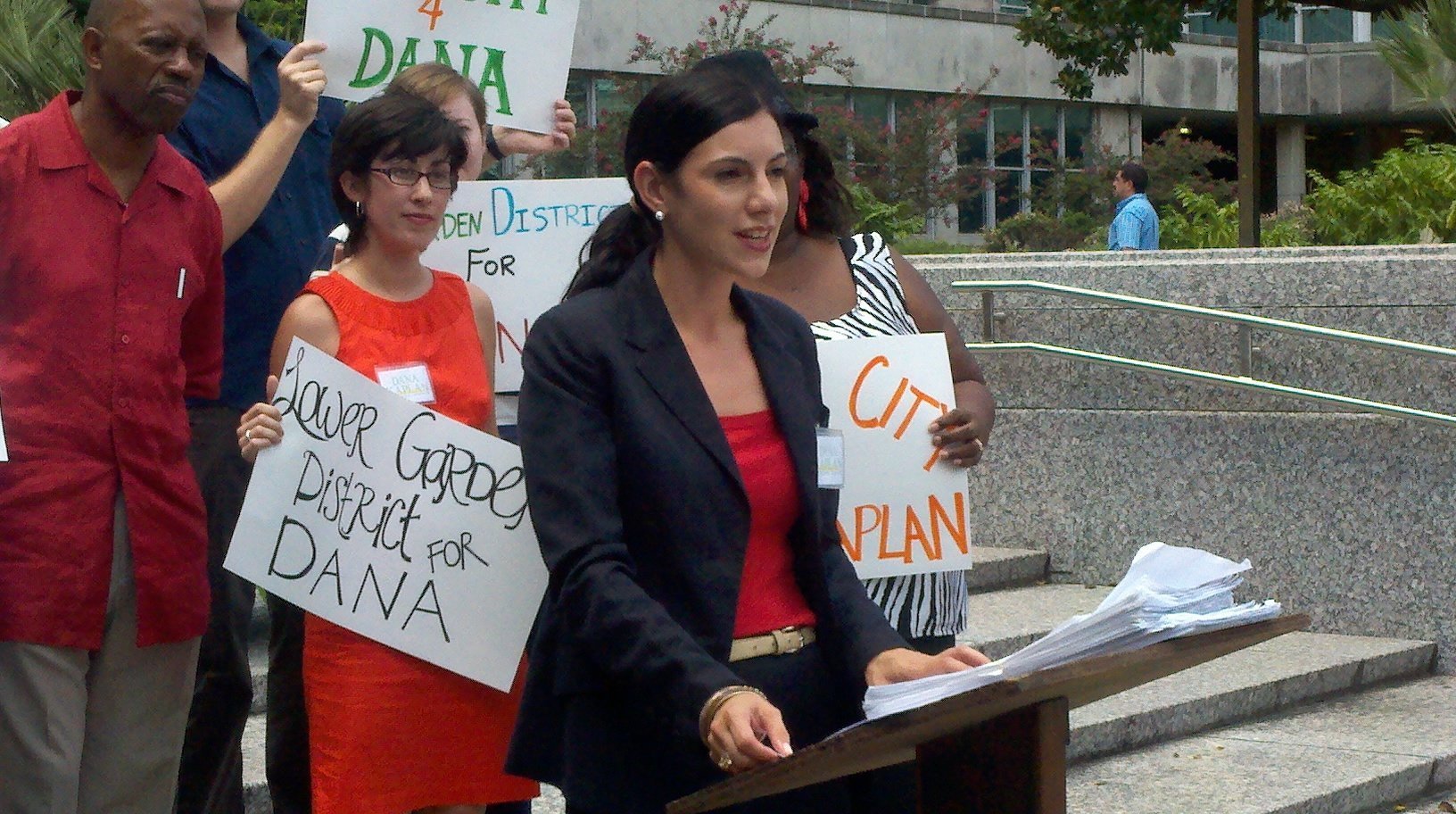
Criminal Justice Expert Poised for NOLA City Council Seat

When Dana Kaplan soared into position for a December run-off election, it became clear that something big is happening in the city of New Orleans- the most incarcerated city in the most incarcerated state in the most incarcerated nation in the world.  Many of us know Dana from her work as executive director of Juvenile Justice Project of Louisiana, or as co-founder of Safe Streets Strong Communities, or further back when she worked with Center for Constitutional Rights and the Prison Moratorium Project.  Although we often see ourselves as “community leaders,” ironically we rarely see ourselves as politicians.

I asked Norris Henderson, her co-founder at Safe Streets, what this election means.  He pointed out Dana’s ability to bring such a diverse coalition together, and how even the Mayor and the Sheriff (her most frequent adversaries) endorsed her.  Respect for Dana Kaplan runs deep, and one has to believe the integrity of Mayor Landrieu and Sheriff Gusman just scored a few points in that they were willing to elevate her into a position with authority over the police and the jail.

But I think it is bigger than Dana Kaplan and New Orleans.  What I see in this campaign is the ability to run a campaign “from the Left,” and make no apologies.  When half of America stays home on election day because they aren’t motivated by the messages or (more importantly) by the actions of two Wall Street political parties, this election shows that politicians need not go to the Center-Right positions just to get the financial contributions.

New Orleans is the center of crime, or at least one could believe by watching the media.  It is a place where “Tough On Crime” and racism have deep history.  It is also a place still struggling from Katrina and BP, and not just the disasters but also the cronyism and corruption that misappropriated relief efforts.  The education system is an experiment being conducted upon “other people’s kids.”  Dana Kaplan is someone who expertly understands the School-to-Prison Pipeline, and how we systemically funnel our kids along it.  JJPL started a program (Stand Up For Each Other) where law students from Tulane and Loyola would represent kids in discipline hearings.  The fact that this became a need, one met by volunteers and not the city, is telling as to the status of boys in New Orleans.

While some politicians are still railing about crushing everything and everyone with anything to do with drugs, or while our presidential campaigns managed to avoid the Drug War entirely, things were being spoken on by The People.  Washington and Colorado voters decided to treat marijuana like alcohol.  Massachusetts’ choice to allow medical marijuana leaves New Hampshire as the only New England state that does not.  Arkansas voted against this homeopathic medicine being legal, yet 49% of the voters wanted it legal.  When the turnout is under 50% of eligible voters, it makes you wonder what the other folks would have voted for.  [Insert pot smoking joke here.]  Clearly, the feds will be last to know: Americans smoke pot, and don’t think it is such a big deal.  Those with a problem should deal with it in some way other than sitting in a cage for a few months or few years.

New Orleans only has five districts and two at-large seats.  A council position can be quite powerful, particularly where someone advocating for new directions can make persuasive arguments like Dana Kaplan.  Last night’s four-way race left her in a statistical dead heat, at 31% to 39% for the frontrunner.  Depending on which way the supporters of the other candidates re-vote, or if turnout can rise above 47%, she could even win in a landslide.  In a city where the jail and the police are under federal supervision, it would be nice if the City can usher the strength to reign those entities in for themselves.

Stay tuned for December…

*Full Disclosure: I volunteered for Dana Kaplan for City Council, and even was the DJ at last night’s celebration party.  Of the few politicians I have volunteered for in my life, I have never had any regrets about how they performed in office.

Posted in Commentary, Drug Policy, Politics | Tagged , , , , , , , , | 1 Comment

Sanchez v. Tebow. Obama v. Romney. Do You Vote For “The Lesser Evil?”

Like most Americans, I love New York but don’t care much for the Jets.  Similarly, I love America, but am not a fan of the electoral system.  No offense to Fireman Ed or Uncle Sam, its just that neither are what I want– its what I’m stuck with.  The electoral system, with its Winner-Take-All electoral college, was surely a great idea a few hundred years ago as an improvement over a King and his elite Lords an ocean away.  Now, it deserves a recount.

In 1789, white male property owners were a small group of voters whose conflicts pitted farm owners against merchants.  The right for slaves to be free, for example, was not up for debate.  The leaders merely debated over whether slave owners could use their “property” to bulk up their districts in the way that prisoners are used today.  Two centuries later, we have more diversity in our economy and our people, yet we hardly see that reflected in our choices for political office.  We also hear more voices advising us to vote for “the lesser evil” rather than who we want.

Choosing the candidate you hate least is like choosing the Jets quarterback.  Mark Sanchez, the incumbent, has come under classic Big Apple scrutiny because his team is in utter disarray and his stats are terrible.  His defenders point out the many other problems on the team, such as injuries, coaching, and a weakening offensive line, yet his detractors don’t want to hear it.  Sanchez has to go.  Meanwhile, Tim Tebow has his own fan base, though it is arguable whether they support him as a quarterback or as an outspoken Christian.  This is the signal caller that Broncos GM (and Hall of Fame QB) John Elway was desperate to ship out of Denver; he believes that Tebow can only win so many games on a wing and a prayer.

The arguments about Obama v. Romney are similar to Sanchez v. Tebow.  And the fundamental question comes down to whether you allow the team leader to continue, hoping for improvement, or do you give another guy a chance to lead? Some people see the field general in the context of his entire organization, while others put more weight on his single contribution.  Jets fans seem to have universally decided Sanchez is not the next coming of Joe Namath, and he is no longer their dream date to the prom.  Now the argument is whether (1) Tebow is so bad, we may as well stick with Sanchez, or (2) Tebow can’t be any worse than what we have, and he might just be better.

Changing quarterbacks, like changing presidents, is a big deal that can take some time to back out of when things turn out badly.  In our Winner-Take-All system, those with 49% of the vote get no voice at all (unlike many other nations).  We are now asked not to choose what we want, but rather to avoid the worst-case scenario.  We are even told that supporting what we want, if it is a third party candidate, can hurt either of the two primary job applicants.  Yet our election history is full of peculiarities that indicate more possibilities than we are sold on television.

In 1824, no candidate earned an electoral vote majority, so the states individually voted, and favored the second place John Quincy Adams over Andrew Jackson (Jackson won the rematch).  From 1876-1892, five elections were decided by margins where the third (or fourth) option could have swung it either way.  In 1876, Rutherford Hayes also became president without the majority of the vote.  In 1912, Woodrow Wilson received less than 50% of the vote, yet earned 435 electoral votes in a “landslide.”  In 1920, Eugene Debs earned 3.4% of the vote from his prison cell.  In 1948, Harry Truman also won with under 50% of the popular vote while third party candidate Strom Thurmond carried 39 electoral votes.  Although he earned practically the same number of votes as Henry Wallace, the latter received no electoral votes.

In 1960, Kennedy beat Nixon by a controversial 100,000 votes, but then in 1968 Nixon beat Humphrey by half a million… while third party candidate George C. Wallace received nearly 10 million votes, becoming the last third party candidate to earn an electoral vote (46).  In 1976 and 1980, third party candidates earned nearly enough votes to nearly cover the margin of victory.

Ross Perot’ candidacy was nothing new in American history, as he ushered in the contemporary concept of the “spoiler.”  Most agree that if two-thirds of Perot supporters voted Republican, George H.W. Bush would have beaten Clinton in 1992.  Likewise, if they all had voted for Bob Dole in 1996, we might have had a recount.  However, it is fuzzy math to reallocate votes even in a hypothetical scenario, particularly when a candidate has some fundamental differences from the others.  Some would argue there was more similarity between Clinton and Bush than Bush and Perot.  Ross Perot did not win an electoral vote in either election, and Clinton won them in electoral vote “landslides.”

In 2000, Ralph Nader earned 2% of the vote (less than Debs did from prison) and some consider him to have given the election to George W. Bush, who did not win 50% of the popular vote.  It is surprising as to Nader’s elevated role in history, particularly when presidential hopeful Al Gore threw in the towel before the recount was complete, and where more people were “accidentally” disenfranchised in Florida than actually voted for Nader.  Most would agree that Republicans and Democrats are more aligned than the Green Party and Democrats, so it is again fuzzy math to go counting Nader votes as “stolen” votes for Gore.

Is third string presidential candidate Gov. Gary Johnson a spoiler?  Some may see him as a Best of the Rest, as they are disenchanted with their own party and the other main alternative looks even worse.  Some will support Johnson because his issues are aligned with theirs, such as taking a new approach to the War on Drugs.  The fact that Republicans and Democrats don’t know which party he draws from the most is significant in two ways: (1) These party members see the world in a zero-sum game, where all constituents have been claimed by two major parties, and (2) Gary Johnson is very independent of their platforms.

As for the Jets, it is time to start Greg McElroy, the second year guy out of Alabama.  If you think its crazy to go down into the third string, here are a few names to remember: Kurt Warner, Tom Brady, Steve Young, and Doug Flutie.  Oh, and New Yorkers might remember a nobody named Jeff Hostetler, who quarterbacked the Giants to a Super Bowl championship.

Posted in Commentary | Tagged , , , , , , , , , , , , | 1 Comment

The Coming Revolt of The Guards… in New York City?

English: New York City Mayor Mike Bloomberg wi...

Bloomberg seeking crime fighters.

Whether it is the war in Vietnam or Afghanistan… or whether the practices of a large police department: the most certain way to change directions is through a revolt of those who carry out the laws and policies of the government: the guards of the status quo.  The revolt can be velvet or painful, may come through protests or discourse, but when the people charged with enforcing the policy decide to stop: it will stop.  This seems to be precisely what is going on in New York City, centering on the infamous “Stop and Frisk” tactics.

This week marks the NYC City Council hearings to reform the NYPD practices.  Yesterday’s packed hearing in Queens included testimony from activists at DRUM, explaining how the NYPD infiltrated their organization.  Such tactics reek of an era supposedly surpassed in this country.  This week also marks a continuation of the court hearing in New York federal district court regarding “Operation Clean Halls,” the NYPD’s policy of stopping and frisking people in public housing.  Judge Shira Scheindlin will hear the case, serving as a precursor to the larger class action Floyd v. City of New York, regarding the broader policy of Stop and Frisk.  The Floyd trial is expected in March, 2013.  This week’s testimony (which is expected to last eight days) not only includes the voices of many actual victims of the aggressive tactics, but also the testimony of a prosecutor who grew suspicious when seeing so many people arrested for trespassing in their own building.  Jeannette Rucker is but one gatekeeper struggling to do her job and prosecute the people arrested.  Her job, however, is not to prosecute every police allegation; her job is to do justice for the people.

This past summer, in People v. Figueroa, New York Judge Noach Dear stated he could not recall the last time, if ever, a White person was arrested for an Open Alcohol Container violation.  He then set a scientific standard for police to prove the alcohol is of the legal level- a standard no field officer could reach.  Former cops are among Stop and Frisk’s opponents, including NY State Senator Eric Adams, who will testify in the Floyd case that the Commissioner’s stated policy goal is to scare young Black and Latino people from carrying a gun, knowing they will be stopped at every opportunity.  A groundbreaking audio recording of one youth being stopped, assaulted, and threatened has prompted even more police to share their own stories of being pressured to randomly stop New Yorkers.

Mayor Bloomberg and Commissioner Kelly repeatedly claim that the policy is working, getting guns off the streets, projecting there were 5,600 fewer murders over the past ten years.  The Mayor says this while also admitting shootings are not being reduced.  The NYPD conducted 524,873 more stops in 2011 than in 2003 (pre-Stop and Frisk), and recovered only 176 more guns.  This additional recovery rate is only .03% more under the most aggressive practices, so clearly gun seizure plays little, if any, part in reducing murders.  Bloomberg apparently takes the early 1990’s murder number when the nation was at its peak, and claims every murder short of that peak is a result of Stop and Frisk– yet rates have dropped nationally, and NYC has a rate similar to Phoenix, San Antonio, Los Angeles, and Las Vegas.   The greatest declines came before Bloomberg took office, and has leveled off over the past decade.

Mayor Bloomberg is not called to statistically prove his speculation of 5,600 lives saved, 90% of whom, he claims, would have been Black and Latino.  It seems to be based on a presumption that murders are tied to a relationship of fear between the police and the community.  With shootings remaining stable, it is difficult to presume there are fewer guns on the streets for those who want them.  He makes no reference to any of the other social forces that contribute to a safe and healthy community, including things other cities may be doing to achieve similar results.

Looking at overall crime, the NYPD Compstat data indicates a reduction of only 2% since 2005.  Misdemeanor drug crimes have increased 31% while felony drug crimes dipped 22%, which may be a change in prosecution rather than behavior. Stolen property, sex crimes, and dangerous weapons (felonies and misdemeanors) have steadily risen over a decade, from about 16,000 to 23,000.  It is a flimsy hook Commissioner Kelly hangs his hat upon, a national trend in murder reduction, and the court is likely to find the hyperbole is not enough to justify the collateral damage to the community.

Hundreds of thousands of New Yorkers are expected to live under a regime of total authority, and simply go about their business when 90% of the time the police find no illegal behavior.  Yet even when there is no crime committed, people can be expected to expend time and money proving it.  Activist Joseph “Jazz” Hayden, known for his All Things Harlem work filming the police, was arrested with a New York Yankees souvenir bat and an unworkable switchblade in his car.  After this probably illegal search, and extensive court proceedings, prosecutors reduced the charges rather than dismissed them.  And this, under the circumstances, ends up being a victory.  Those who wonder how ten million people, disproportionately young men of Color, are currently under the control of the criminal justice system need look no further than the example of Stop and Frisk.  Criminal records start with petty things that may or may not have been committed.  Each arrest, innocent or not, compounds with the last and makes it increasingly difficult to find legitimate housing and employment.

Howard Zinn’s classic book A People’s History of the United States presents many chapters in our nation’s history where popular movements struggled against the forces of power and control.  His essay, “The Coming Revolt of the Guards,” is rooted in the Constitutional principal that the government draws its power from the consent of the People, and government power relies upon those who guard its authority.  Many with friends and family in law enforcement, government, or the military, likely realize “just following orders” can be a tempting directive for anyone trying to feed their family.  Some police, prosecutors, and judges appear to be reconsidering.

It is hard to know when a critical mass has been reached, of when consent has been officially withheld.  It would appear that this mathematical equation is being tallied across New York City, in places such as Harlem, Bed-Stuy, and the courts.

Posted in Commentary, Courts, Police | Tagged , , , , , , , , , | 4 Comments