Are you in a job or a Movement?

Crowds surrounding the Reflecting Pool, during...

In the world of social justice there is a frequent reference to “The Movement.”  For those weary of being characterized as a “Lefty,” they may still refer to “a movement” or “movements” in recognition of ideas taking hold at a grassroots level and changing the consciousness of the nation.

But what sparks a Movement?  What catalyzes an issue that goes viral in the streets?  We can’t have structural changes unless those sparks are traveling through some sort of structure as well.  Movement structure differs from government structure.  We think of government as “Top Down,” even if democracy is (in theory) “Bottom Up.”  Government officials tell you they want to “run it like a business” and flaunt their corporate experience, not their grassroots organizer experience.

Football Team StructureConsider the structure of a football team, where the direction of the team travels from owner down to the very last player.  Some owners are more involved than others, some more knowledgeable, but ultimately their job is to put the coaches in position to win.  Coaches must direct the quarterback, who in turn must micro-manage each play and enable his backs and receivers to score.  Others will block for the backs and receivers and, ultimately, the entire team wins.  Certain members of the structure get glory or blame, deserved or not, and the owner can fire people at will.

The football team is a classic top-down corporate structure, although the coach and quarterback are given significant discretion.  We understand it and accept it.

Bad Movement StructureNow consider what some may consider the current Movement structure, since the professionalization of social justice that occurred in the wake of the Civil Rights Movement in the 1960’s.  After radical leaders were murdered and imprisoned, and the era faded into history… for mainstream America insulated or disconnected from social justice issues such as poverty, failing schools, imprisonment, and police brutality.

It is not a terrible thing that there is funding for organized (and individual) work in the social justice sphere.  It is not a bad thing when government is enlisted to join in the development of strong and healthy communities, particularly when using their enforcement power against those who are exploiting the most vulnerable.  But although there are exceptional funders and members of government, they too recognize that they are exceptions.  Many people in these powerful positions are either inadequately informed, disconnected, or elitists who “know better.”

Many parts of this “[m]ovement” are only willing to strive for changes that the government is willing to allow, and the funders have declared is their focus area.  In this scenario where affected people in the field are so disconnected from the coaches and quarterbacks calling the shots, the brain trust is not always moving the movement.  Complicating matters is the struggle for people to collaborate and coordinate the further up the chain you go.  People reinvent the wheel, and fail to gain momentum with others’ success.

Proper Movement StructureConsider another model for a Movement.  Consider that, even in a “top down” structure we can put the grassroots at the top.  Each supports the one’s above. Movement lawyers, for example, are there to support the Plaintiffs, who are there to support and represent a broader group of people and problems in need of attention.

Funders, academics, and government actors play a foundational role for the entire team to win.  They serve, along with the affected people, as the base for their resources to support the work of those above them.  But the key is that they take their cues from those above them.

In order for a Movement to be an honest depiction of people’s needs, the ideas and actions need to be produced by the people in need.  People on all parts of the spectrum need to have a form of checks and balances that works for them.  There is no room for elitism, and we have no time for leaders whose followers are just following the money.  If  heart and soul are not pushing your actions- regardless of how you pay the bills- then you are not in a Movement.  You have just another job in a corporate structure.

Posted in Commentary, Movement Building | Tagged , , , , , , , , , | Leave a comment

Fed Court Rules on Racist Crack Law- SCOTUS on Deck

A pile of crack cocaine ‘rocks’

A pile of crack cocaine ‘rocks’

After decades of public agitating that the federal sentencing laws are creating racist results, Congress famously lowered the 100-to-1 weight ratio (cocaine powder to crack) down to 18-to-1 with the Fair Sentencing Act in 2010.  A significant remaining question is what to do with thousands of people languishing in prison under a defunct law.  If the old law was unfair, or unconstitutional, does that make their sentences unconstitutional?

This week the 6th Circuit ruled in U.S. v. Blewett that those sentences are in fact unconstitutional, and the law should be applied retroactively.  Their rationale centers around the fact that although the law was not initially crafted with an intent to discriminate, and treat Black people more harshly, years later it became universally accepted that it does just that.  Thus, to now maintain those sentences is to do it with the intent to discriminate.  This is a powerful rationale.

It might be simpler to decide the straightforward question of whether Congress intended the new law to be retroactive, and most observers expected federal courts to focus on that.  This court, just one step below the U.S. Supreme Court took a broader approach of incorporating Equal Protection under the 14th Amendment.

Fairness v. Discriminatory Intent

According to Senate Judiciary Chairman Patrick Leahy, the 100-to-1 ratio is “one of the most notorious symbols of racial discrimination in the modern criminal justice system.”  156 Cong. Rec. S1683 (daily ed. Mar. 17, 2010).

Many policies seem to be neutral on their face.  Nobody says “pass this law so we can round up all the young Black males and put them away forever.”  (Not on the record, at least).  Yet when the War on Americans known as the “War on Drugs” kicked into gear: law enforcement overwhelmingly targeted Black Americans, and overlooked the clear majority of drug users: White Americans.  Not only do the latter have far more actual drug users (which makes sense if a group is three-quarters of the whole), but they also have higher individual rates of usage.  And yet over 80% of federal crack defendants have been Black American people, despite Whites using more crack.

Congress and the courts have since concluded that the 100-to-1 ratio was based on no empirical evidence, and realize a few $20 “rocks” will garner the same sentence as large bag of powder worth thousands of dollars.  Basically, the sentencing structure was inverted, and the Big Willy dealer got less than the small time user- in direct violation of publicly claimed goals of stopping drug dealers.

What is the impact?  Will 13,000 People Return to Their Families?

The 6th Circuit has binding federal law in Kentucky, Michigan, Ohio, and Tennessee.  This case will be persuasive in the other courts that have yet to rule on the retroactive application of the Fair Sentencing Act.  The real impact will be if, and when, this rationale infiltrates state courts.  Federal prisoners constitute about 15% of all 2.5 million prisoners in America.  And yet 15% of the federal prisoners (30,000) are serving time for crack.  The bulk of this problem exists in state laws, state enforcement, state budgets, and state cultural levels of acceptance for racial disparity.

17,000 people would not be eligible for relief, even assuming this decision becomes the law of the land, because their sentence triggered other pieces of the complex sentencing provisions, such as “career criminal.”  Yet 13,000 could be eligible for release or halfway houses as soon as they could be re-sentenced.  The federal government is certainly petitioning the Supreme Court for review, which may take the case out of anticipation of another Circuit claiming otherwise (and may in fact wait for that to happen), and they will seek a stay of execution.

English: The United States Supreme Court, the ...

English: The United States Supreme Court, the highest court in the United States, in 2010. Top row (left to right): Associate Justice Sonia Sotomayor, Associate Justice Stephen G. Breyer, Associate Justice Samuel A. Alito, and Associate Justice Elena Kagan. Bottom row (left to right): Associate Justice Clarence Thomas, Associate Justice Antonin Scalia, Chief Justice John G. Roberts, Associate Justice Anthony Kennedy, and Associate Justice Ruth Bader Ginsburg. (Photo credit: Wikipedia)

The Supreme Court

The Court spoke on the Fair Sentencing Act in 2010 (Dorsey v. United States), and clearly acknowledged the factual racial disparity, while concurring in Congressional intent to right the past wrongs.  In that case, it was decided that people whose crimes predated the Fair Sentencing Act, yet their sentences came afterwards, were to be controlled by the Fair Sentencing Act- not the old 100-to-1 law.  The ruling was 5-to-4, with Scalia writing a dissent joined by Roberts, Thomas, and Alito.  Because Scalia and Thomas rarely see a punitive measure they disagree with, and the more punitive the better, they can typically be counted upon for their positions.

The Dorsey decision, penned by Justice Breyer, left open the question of full retroactivity because that was not the case before them.  This court could agree with the 6th Circuit, yet create different reasoning.  Or, of course, they could shoot it down.  The reasoning is essential to the case as it can guide other applications of policies that create “disparate impact”- where a non-racist law results in racist outcomes.  Policing patterns and tactics, such as non-enforcement on college campuses and Stop-and-Frisk based on “reasonable suspicion,” need a fresh analysis as to whether they conform with our fundamental principles of Equal Protection under the law.

A further indication of the Court’s approach might be found in the forthcoming Shelby County v. Holder decision.  This Voting Rights Act case was well framed by Scalia when he opined, regarding the protection of voting rights, “isn’t this just another racial entitlement?”  Clearly, at least one jurist can characterize the protection of a fundamental right as a bad thing needing elimination.  How traditional swing justice Kennedy rules is important, as well as not-entirely-predictable Kagan, Alito, and Chief Justice Roberts.  Whoever writes the Shelby County decision has an opportunity to provide the Court’s framework on civil rights and equal protection for years to come.

English: Antonin Scalia, Associate Justice of ...

English: Antonin Scalia, Associate Justice of the Supreme Court of the United States (Photo credit: Wikipedia)

Justice Scalia’s Error

Scalia will once again assert that the law requires an express intent by Congress for this new Act to be retroactive.  And that case precedent allows for a “fair implication” (past usages have been “clear” and “plain” implication).  He doesn’t see that here.  But he operates from a mistaken premise that the old law was constitutional, and fairly applied.

Congress did not create the new law simply because they decided to be more lenient on crack offenders.  They struck down the old law because they recognized it had a racist application and racist result- this is in the Congressional Record.  Thus, the proper questions are layered:

  1. Should the Fair Sentencing Act apply retroactively based on Congressional implication?
  2. Is the former sentencing structure, 100-to-1, a violation of Equal Protection where Congress has acknowledged its racially disproportionate impact?
  3. Can the intent of “disparate treatment” attach after a policy, drafted neutrally, becomes accepted as having disparate impact?

Correcting Injustice

Our nation is often slow, imprecise, and incomplete when it comes to correcting injustices- with the most notorious being slavery.  To publicly suggest, today, that slavery deserves any legitimacy is akin to suggesting that Hitler’s treatment of the Jews was understandable.  Yet this universal agreement did not happen in 1861, nor 1866; it took roughly five generations to create actual race-neutral laws in America, and it has been only two generations since that change.

Our criminal justice policy in America, particularly the drug prohibition, is akin to our slavery policy of 1859.  Most people realize it is anywhere from problematic to catastrophic.  And even when we see a change, such as the Fair Sentencing Act, it is without the authoritative power of flags waving Truth, Justice, and Equality.  We send teenagers off to foreign lands to “Defend Freedom,” with F-16 jets flying at sporting events, and yet we half-heartedly recognize that this racist policy should be “less racist” (rather than ending completely), and those who suffered under the racist regime, well… sorry.

The 6th Circuit majority (Judges Merritt and Martin) recognize that the old law has been deemed “racist” by the body that created it, and Equal Protection requires this more informed characterization to hold sway.  As they say about the Dissenting judge:

“The dissent then refuses to acknowledge, come to grips with or rebut the equal protection argument in this case. The dissent fails even to acknowledge the language of the Supreme Court in Dorsey stating that Congress found the old 100-to-1 ratio to be racially discriminatory and therefore reduced the penalty to 18-to-1. Nor does the dissent acknowledge or rebut the many legislative history statements that the law the dissent would continue to apply is blatantly racially discriminatory. The dissent only cites United States v. Hammond, No. 12-5522, 2013 WL 1363908 (6th Cir. Apr. 5, 2013), as authority. The Hammond case does not purport to deal with the equal protection problem. A dissent that refuses to acknowledge the main problem in a case and then relies primarily on a case that does not mention the problem is not responsive or relevant. In order to be responsive, disagreement at least requires a discussion about why we should continue to hold thousands of people in jail who are there because of a law that is acknowledged to be racially discriminatory by a majority of the Supreme Court and by the vote of a large majority of the Congress of the United States. Congress does not often acknowledge that it passed a racially discriminatory law and then try to redress its own prior mistake. To be relevant, a dissent must at least try to deal with that issue.

In 2013 we are likely to see another Circuit’s opinion on the matter, and in 2014 we are likely to hear from either Breyer or Scalia, depending on which Supreme Court justice can swing four of his brethren.

Hopefully, at least some of the impacted people will read these rulings from the comfort of a home rather than the continued cold confines of a cellblock.


Posted in Drug Policy, Race | Tagged , , , , , , , , , , , , , , , | 1 Comment

Eliminating Food Stamps to Former Prisoners

English: Logo of the .

Congress unanimously passed an amendment to the Farm Bill, to bar some people convicted of violent crimes from food stamps.  States can’t opt out of it like the ban on people with drug convictions.

This is what I emailed my Senator, David Vitter, although I am not allowed to vote for or against him, who sponsored this rider:

“Considering that LA is the incarceration capital of the world, I am surprised that only 1700 people who were in prison could access Food Stamps during the 3 year period cited by the Senator. There are 45,000 people on probation and parole. So even if these people were recently involved in the justice system, and still serving a sentence, this would only be 4% of people getting some food assistance, it is no wonder recidivism is so hard to reduce.

I received Food Stamps for about 5 months while on parole. It was a crucial help at a critical time. I have since paid thousands of dollars in fees to the justice system. I have paid thousands in taxes. I will ultimately pay about six figures to the Senator’s own alma mater: Tulane Law School. Those of us who committed a violent crime are not inherently “dangerous” for life, but I recognize that there are some people who would like to not see us succeed. This bill will surely pass, as will many like it, and some of us will succeed nonetheless. However, it takes a lot of sincerity out of the purported efforts (fed/state/local) to “help” us get our lives together. So while it is understandable that some people will never accept us in their neighborhoods, they should also understand those who do not trust any governmental efforts to rehabilitate and reenter. Without that trust, those programs will be no more than an occasional photo-op.

I respectfully request the Senator to reconsider his approach to Food Stamps. A month of benefits = 2 days of what the federal government pays to incarcerate someone.”

Who remembers the woman who lied about her conviction in order to get Food Stamps for her children?  She is in prison and the kids are eligible for the program now that they are children of a prisoner.

Kafka, eat your heart out.

Posted in Legislation, Rehabilitation | Tagged , , , , , , , | Leave a comment

New Report on Public Housing: “Communities, Evictions, and Criminal Convictions.”

Housing Report CoverI first encountered this public housing issue over a decade ago while living in Rhode Island, and finally began legal research while in New York City last summer.  It is national in scope, and much of the relevant law is federal.  However, I felt it would be easier to comprehend if focused on a particular city.  I moved to New Orleans in 2011 and do not pretend to fully understand the entire socio-political landscape.   To the degree that this report is incomplete, such as detailed data on evictions, I apologize.  What follows is meant to be a starting point on a complex issue, rather than an ending point.  I expect others to capitalize on this consolidation of material and move forward in their own regions or specialties.

This report would not be possible without the families of convicted people standing up and resisting discrimination.  In particular, members of Stand with Dignity have been instrumental in advocating for changes outlined in the report.  I thank their organizers, Toya X and Collette Tippy, for connecting with me.  Very little of my work in New Orleans would be relevant if not for my fellow members of Voice of the Ex-Offender (VOTE) and Norris Henderson.

As Dorsey Nunn, of the Formerly Incarcerated & Convicted People’s Movement, writes in the Forward:

This report represents more than just a legal analysis about the struggles in low-income communities.  For many of us, this is about our homes.  This is about where we try to cook our meals, relax, and raise our families.  The stakes are high, inciting passion.  Yet we do not let this passion blind us; instead, we use it to motivate ourselves.  We encourage everyone, regardless of background or circumstance, to join us in taking action upon a most critical issue.

We are fortunate to have strong individuals and organizations working towards change in New Orleans.  The city is “ground zero” for incarceration, and a true tragedy considering the rich history and difficult geographic location at the mouth of the Mississippi.   What we have created is a national model, drawing from the expertise on the ground and in the legal community, to help our people step up and out of the carnage created by two generations of the “War on Drugs.”

The FICPM looks forward to building partnerships with people working on this and other issues across the nation.

Sincerely,

Dorsey Nunn

Formerly Incarcerated & Convicted People’s Movement

Download “Communities, Evictions, and Criminal Convictions” HERE.

Posted in Housing | Tagged , , , , , , , , , , , , , , | 4 Comments

Do Colleges Encourage Racial and Class Superiority?

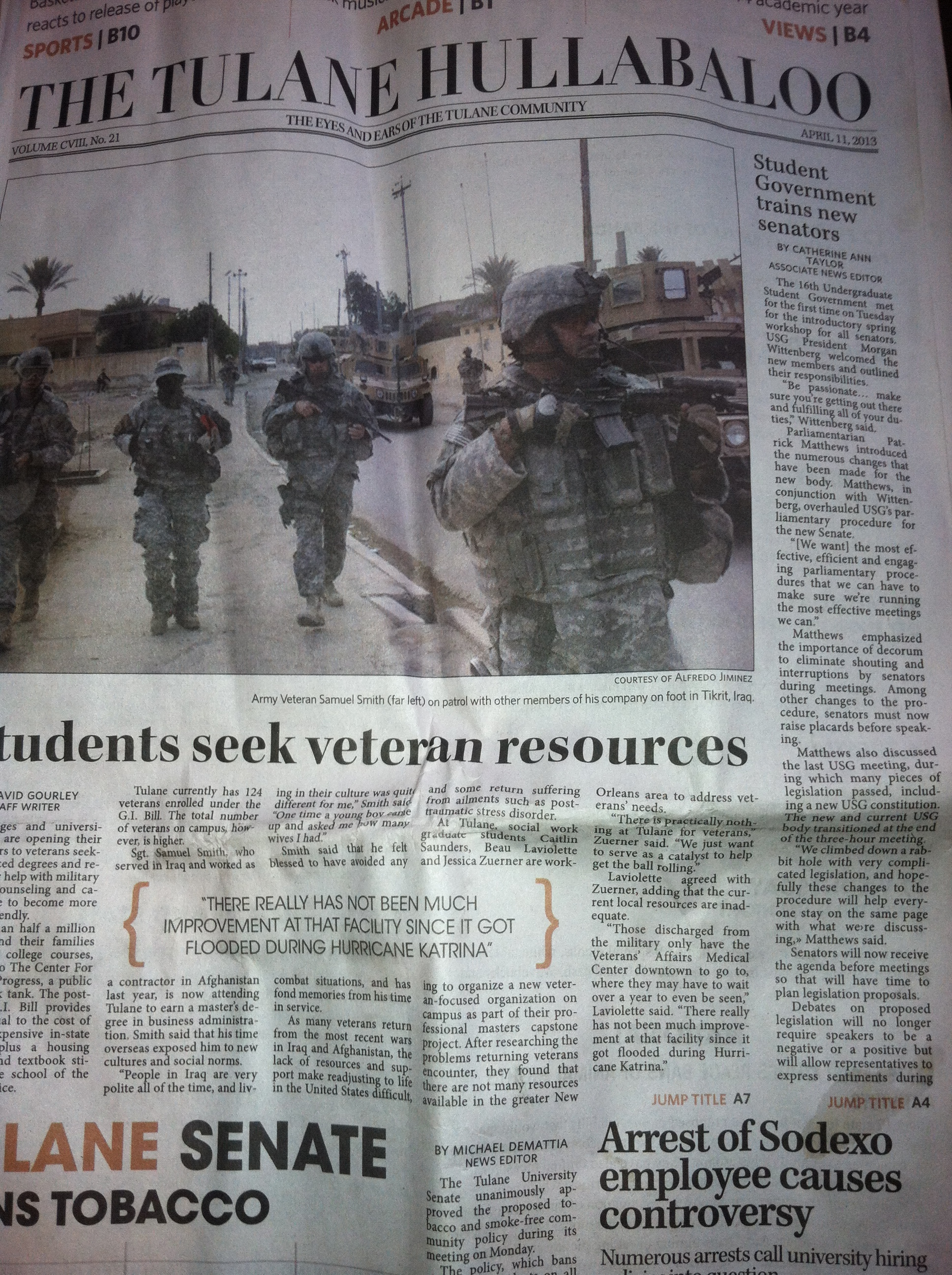
Hullaballoo

What’s wrong with the picture above?  Most won’t see it, even if they read the entire paper- which is why most people “just don’t get it.”  Where corporate media reinforces stereotypes and racial/class divisions, universities are supposed to be bastions of idealism where young people are taught to resist the gritty “-isms” that are at the heart of so much strife.  My university newspaper, the Tulane Hullabaloo just pulled a classic with just five stories in the latest issue: (1) An employee is arrested on campus; (2) Research on ketamine; (3) Ranking “Party Schools;” (4) Campus anti-rape campaign; and (5) a White “White Collar” criminal.

food-serviceArresting the Working Man

“Arrest of Sodexo employee causes controversy” is a front page story, with a sub-headline: “Numerous arrests call university hiring policies into question.”  It just so happens that most of the service jobs on campus are held by People of Color, while about 70% of the students and faculty are White.  It is presumed that any employee with a history of arrests poses a threat to others.  What isn’t mentioned is whether a hiring policy should be based on lifetime punishment of those with a criminal record, or based on suspected safety of students, or something else?

So lets talk about student safety, and who in fact poses a threat.    On page A4, a less prominent article notes that BroBible ranks Tulane as the 21st top “Party School,” a ranking that disappointed at least one student.  One factor that raised our ranking is a recent drug bust at a fraternity, involving a range of substances, that were of ‘Drug Dealer’ quantities.

This bust, of White college students, likely came as no surprise to anyone in America.  Yet the man serving me my food at the cafeteria calls the university’s hiring policies into question.

SpecialK_Logo.epsDiscovering the Joys of Special K

Speaking of party culture, the popular rave drug ketamine (“Special K”) is going to be studied at Tulane for its potential antidepressant qualities (Page A3).  Their hypothesis could be summed up as “Special K makes young people feel better.”  This could serve as a major breakthrough in the treatment of depression (ketamine’s primary legal use is as a horse tranquilizer).

Even ketamine research is less important than discussing the ability for people in New Orleans to make a living.  New Orleans is a majority-Black city, which is also the most incarcerated city in America.  Roughly 15% of Black residents are not allowed to vote.  Any hiring policy by Tulane, the city’s largest private employer, is likely to have a major impact on People of Color and people with a criminal record.

images-7Rapists on the Loose?

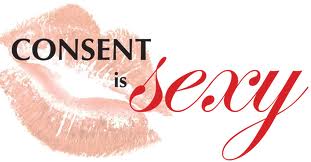
In the quest for college campuses to be safe, a national campaign to change the culture is afoot: “Consent is Sexy” (See: Page B5).  The writer notes that rape is “rampant” at colleges, having evolved into “rape culture.”  Is this fear directed at the service employees on campus?  No.  Rape Culture, along with “Party” and “Drug” activities, refer to the predominantly White middle/upper class students.

The employee story continues on Page 7, under the heading “Fugitive.”  What, you wonder, was the Sodexo employee wanted for?  He didn’t show up to court for outstanding traffic tickets, probably because he felt he needed to show up for work that day instead.  This “fugitive” was arrested at work a few miles from the courthouse.  The article mentions his past history includes marijuana charges.  Whoa.  Perhaps he can’t be trusted around the snacks.

Professional Criminals… with White Collars

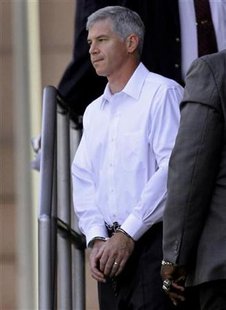
2011-05-18T151803Z_01_BTRE74H16IP00_RTROPTP_3_BUSINESS-US-ENRON-FASTOW_JPG_475x310_q85Speaking of criminal convictions, another article highlights esteemed corporate lecturer Andrew Fastow, former Enron Chief Financial Officer, discussing business ethics.  Fastow served six years in prison as one of the top criminals (convicted, at least) in American history.  I will be the first to mention that much can be learned from formerly incarcerated people.  Yet, it is ironic that Fastow came and went without much fanfare.  He works at a corporate law firm in Houston, likely with access to sensitive information.

So on the back pages we have a White collar criminal, White rape culture, White drug use, and a White party drug.  But the front page story is about whether or not a pot-smoking guy who didn’t show up to traffic court is dangerous, or worthy of serving food to wealthy White kids or mopping floors of the University.  I don’t know the ethnic background of the Sodexo employee, but it doesn’t matter.

One issue of one college’s student newspaper is a clear example: Some people just don’t get it.

Posted in Education, Employment, Race | Tagged , , , , , , , | Leave a comment

The Lowdown on Accidental Racism

English: American country musician Brad Paisley.

The sensational buzz around country star Brad Paisley‘s song “Accidental Racist” is perfect fodder for a Twitter blurb- but is this the extent of racial analysis we can muster in America?  If someone stops reading this article at the first sentence, I feel like this provides a more appropriate response than the shallow condemnations filling the airwaves.  First for some caveats, because I respect that our own experiences fuel our opinions:

I am a man from the North who lives in the South (less than two years) who can’t trace his lineage back into the 1800’s at all.  I forgot everything taught to me in school and replaced it with over a decade of independent research on a variety of topics, especially history.  I learned my deepest lessons on race relations from close affiliations with multiple self-acclaimed racists of various colors and intensities; I learned it in prison.  Since my release I have been in an anti-racist social justice community that strives to confront racism and find pathways beyond this beast.

Now back to the song:  I don’t find it particularly good, on its artistic merits.  I don’t listen to much Country, so I suspect many non-Country fans will be instantly turned off simply by the sound of it.  Similarly, I don’t think I can take another Lil’ Wayne song which basically sounds like he was in the studio smoking weed with some strippers and someone left the mic on.  But when I say Mos Def, Immortal Technique, Rage Against the Machine, Led Zeppelin, Metallica, and the Grateful Dead are among my all-time favorite bands, its clear that the genre isn’t my problem.  “Accidental Racist” isn’t very poetic nor musically dynamic.

But I like this song.  The courage of both Paisley and LL Cool J is admirable.  Surely some agent or other was telling them “Nooooo!!!!!”  Paisley probably doesn’t know this, but the most common theme among People of Color, when discussing racism, is that White people need to go back and educate their White families, colleagues, and neighbors about racism.  I imagine that only certain radio stations are going to play this song, and a certain demographic will buy this album- the same demographic that White anti-racists are called upon to reach.

It is not easy to get an anti-racist message out to mainstream America, particularly one which is digestible to the group you want to change.  A documentary on the horrors of imprisoning families suspected of migrating to America without government permission, one which condemns racist statements of various actors, may win a human rights film festival and be seen by every activist I know… yet not enlighten a single person with racist tendencies (be they subconscious or overt).  So how do we reach them?

A message has to be heard to be effective.  One that merely reinforces what you already believe is of little use except where it helps to clarify your thoughts and elevates your understanding.  To get people to examine their own beliefs, the message (and the messenger) needs to meet you where you’re at.

In the social justice policy sphere, we recognize that there are not enough true believers in equality and caring about the least fortunate.  So we spend a lot of energy trying to convince Conservatives and “Tough On Crime” Liberals that they should change course.  The most popular tactic lately has been the finances: it costs a lot of money to patrol, arrest, and incarcerate millions of Black, Latino, and poor White people.  The reality is, the approach is to speak in terms they can understand.

If I can get you to the table, we have a chance of building a conversation and learning what your needs and fears are.  If I can get everyone on the spectrum to just move a little bit in the direction I’m headed, then each movement is a victory.  A Liberal wakes up and realizes the Drug War needs to stop; a Moderate becomes outspoken against the racist undertones of Voter ID and drug testing TANF recipients; a Conservative decides to not oppose a decision to close a local jail; a Klan member stops going to secret rallies…  Its all about moving people a little bit.

“To the man that waited on me at the Starbucks down on Main, I hope you understand
When I put on that t-shirt, the only thing I meant to say is I’m a Skynyrd fan
The red flag on my chest somehow is like the elephant in the corner of the south
And I just walked him right in the room
Just a proud rebel son with an ‘ol can of worms
Lookin’ like I got a lot to learn but from my point of view”
The Hook:

“I’m just a white man comin’ to you from the southland
Tryin’ to understand what it’s like not to be
I’m proud of where I’m from but not everything we’ve done
And it ain’t like you and me can re-write history
Our generation didn’t start this nation
We’re still pickin’ up the pieces, walkin’ on eggshells, fightin’ over yesterday
And caught between southern pride and southern blame

They called it Reconstruction, fixed the buildings, dried some tears
We’re still siftin’ through the rubble after a hundred-fifty years
I try to put myself in your shoes and that’s a good place to begin
But it ain’t like I can walk a mile in someone else’s skin”

LL Cool J:
“Dear Mr. White Man, I wish you understood
What the world is really like when you’re livin’ in the hood
Just because my pants are saggin’ doesn’t mean I’m up to no good
You should try to get to know me, I really wish you would
Now my chains are gold but I’m still misunderstood
I wasn’t there when Sherman’s March turned the south into firewood
I want you to get paid but be a slave I never could
Feel like a new fangled Django, dodgin’ invisible white hoods
So when I see that white cowboy hat, I’m thinkin’ it’s not all good
I guess we’re both guilty of judgin’ the cover not the book
I’d love to buy you a beer, conversate and clear the air
But I see that red flag and I think you wish I wasn’t here”

I’m just a white man
(If you don’t judge my do-rag)
Comin’ to you from the southland
(I won’t judge your red flag)
Tryin’ to understand what it’s like not to be
I’m proud of where I’m from
(If you don’t judge my gold chains)
But not everything we’ve done
(I’ll forget the iron chains)
It ain’t like you and me can re-write history
(Can’t re-write history baby)

Oh, Dixieland
(The relationship between the Mason-Dixon needs some fixin’)
I hope you understand what this is all about
(Quite frankly I’m a black Yankee but I’ve been thinkin’ about this lately)
I’m a son of the new south
(The past is the past, you feel me)
And I just want to make things right
(Let bygones be bygones)
Where all that’s left is southern pride
(RIP Robert E. Lee but I’ve gotta thank Abraham Lincoln for freeing me, know what I mean)
It’s real, it’s real
It’s truth”

Could Paisley have left the Confederate flag out of the song?  Perhaps, but he would have been evading the most prominent symbol of racism.  A swastika is universally condemned, yet the Stars and Bars fly freely around this country.  But what the singer suggests, to me, is that symbols mean different things to different people.  Many viewers see the flag and basically equate the one displaying it to a Klan member.  Those flying it, however, may be Southerners at various points of a spectrum on racial views.  It is doubtful that a lecture from Obama, or even a Congressional law banning it, will change many attitudes.

LL’s line about forgetting the iron chains is a tough line.  Some people would like to forget and move on, while others still think there needs to be closure- with Reparations being required.  Considering there were roughly 40 million Americans in 1870, yet over 50 million have immigrated since then, it is obviously difficult to allocate slavery reparations to actual descendants.  I believe the money could be spent on housing and education among low income People of Color, a systemic investment (in the same way the American system protected and enabled slavery).

Either way, it is difficult to have a fresh dialogue without putting aside, even for a moment, the sins and sufferings of the forefathers.  What is perhaps most relevant is identifying the unbroken timeline between slavery and today, regarding America’s laws and attitudes.  And if this were solely a Southern problem, laid at the feet of Southern men who have become the face of repression… this ignores the situation in all parts of the nation.  History is full of selective amnesia, and there is plenty of blame to go around for past and present oppression.

Robert E. Lee is not labeled a “traitor” in American history.  After the war, he became the president of a university and is highly regarded by the U.S. military for his tactical ability.  Statues of him are aplenty.  He more than likely (along with many slaveowners bankrolling the Rebellion) passed along considerable wealth to his children.  His lionization and acceptance is, dare I say, similar to hating Al Qaeda while appreciating Osama bin Laden’s leadership skills.

The inability to properly condemn the leaders of the Confederacy, while blaming the rank and file soldier, is consistent with a structure where the poor are always manipulated to fight the rich man’s war.  People in the South died by the hundreds of thousands.  They overwhelmingly died in the South believing their lands were under attack.  In the past century, the same could be said about Iraqis, Vietnamese, Germans, and so many more.  People need to be allowed to honor their dead, in their own ways.

I am far from an apologist for racism, yet I recognize that we live in a nation where local leaders and institutions surround young people with many remnants of the Rebellion.  History has not eliminated it- I go past Lee Circle and Jeff Davis Boulevard all the time, among other names such as Jackson, MLK, and Simon Bolivar.

I have had cellmates from the North and South, I have lived in a box with members and leaders of the Aryan Brotherhood, Hell’s Angels, Five Percenters, and Latin Kings, among others.  Many of them never heard a guy like me speak before, and I likely would have dismissed their views without any critical discussion until we were forced into the situation.

I’ve seen opposed racists play sports together, work out together, and actually moderate their expressions over time.  One Neo-Nazi tried to shred his knuckle tattoos off with steel wool, because he didn’t hate people as much as when he was a kid getting beat up by others who looked different than him.

With the movie “42” coming out in a week, people might approach that movie knowing Jackie Robinson did not cast a magical spell over America that Black athletes were good people.  Similarly, Jesse Owens returned to a racist and segregated America, flag in hand, after showing up the Nazis.  Even Abe Lincoln did not think too highly of those families he freed; he merely saw it as pragmatic.  The point is: we reach people where they are at, and just try to move them a little bit.

The Anti-Haters need to stop the hate.

Posted in Race | Tagged , , , , , , , , , , | 2 Comments

GEO Withdraws $6 Million Stadium Deal Amidst Public Outcry

Screen Shot 2013-02-19 at 4.14.56 PMThere will be no more private prison sponsorship on the FAU stadium.  Apparently the corporate prison industry is not so proud of their work after all.  The GEO Group offered $6 million to name Florida Atlantic’s football stadium after their company, and the public promptly called it “Owlcatraz.”  The world’s largest imprisonment profiteer, who lobby state and federal legislators (and donate to their campaigns) to create more prisoners, apparently are not so beloved by the general public.

This “coming out” for GEO is actually a good thing.  More people need to understand who  these corporations are, how they make their money, and how brazen they’ve become.  Meanwhile, GEO and others need to know that the public is ready to revoke their right to exist as a profit-making entity.

State legislators have given corporations the right to own humans, and be compensated by the taxpayers.  Perhaps this momentum can turn to look at that little detail.


Posted in Actions, prison economics, Private Prison | Tagged , , , , , , , | 2 Comments

Torture, or Mental Health Treatment? Leaked Video Shows American Prison Conditions

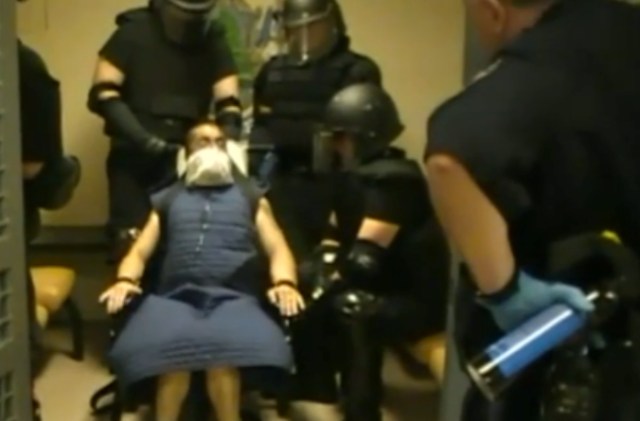
Maced Prisoner

“Help, I can’t breathe,” a prisoner calls out through a fabric mask that was placed over his nose and mouth after pepper spray was shot into his face from inches away.

“You’re Talking, You’re Breathing,” says Captain Welch, in a calm monotone.

Its not easy to deal with people who have mental illness.  They do not always respond in a desired manner, and are sometimes impacted by their medication, or incredibly distorted by their current conditions.  Take a mentally ill person who cut themselves up to the point of being stapled, and then put them into an isolation chamber.  Give them no books nor stimulation.  Perhaps be late with their pain medication, or their anti-psychotic meds. They may not comply.  They may in fact, be so belligerent you dread being around them.  You may feel inclined to take action.

It takes special training to deal with severe mental illness, or even to deal with moderate mental illness in severe conditions.  The most common place for these interactions are behind the walls of American prisons.  Some of these interactions are day-to-day occurrences in the open cell block.  Many of them, however, are away from all eyes except an armored tactical unit, extracting a man from solitary confinement, and bringing him into an even more secluded area so that he may “understand” how to act appropriately.

“We are only trying to help you,” the Captain says in a video anonymously released from the Maine Department of Corrections. Few Americans are privileged to see the “help” a mentally ill prisoner can expect to receive if they are acting out or “decompensating,” to use the medical term.  This incident is nothing special; similar procedures happen in every prison across the nation.  After being maced for obscure retaliatory purposes, he remained strapped down for a half hour before being allowed to wash off.

The incident begins on June 10, 2012, with a 27-year old man, “Paul” in a solitary confinement cell, barefoot in a smock, with nothing but a blanket.  He is a former medic in the military, who was discharged for bipolar and depression.  Paul wants his meds and he wants a book.  Two days earlier, he cut himself deep enough to lose two pints of blood.  Paul has possibly refused to eat his food for days, and complains that he is not getting his Adivan medication to remain, as he says, “somewhat stable.”  The guard tells him to put his bandages back on his arm.   Paul covers himself in his blanket as the camera rolls.  A guard tells Paul that he will need to go to the infirmary so they can re-wrap his bandage, while Paul asks why they can’t come to him.

1987 Ativan advertisement. "In a world wh...

1987 Ativan advertisement. “In a world where certainties are few…no wonder Ativan is prescribed by so many caring clinicians.” (Photo credit: Wikipedia)

Ativan is an anti-psychotic.  A nurse eventually comes and gives him the Ativan,  Zoloft,  Vicodin (for the pain), and something else.  He continually asks for a book, and he and the guards all go back and forth between politeness, subtle threats of violence, insults, and sarcasm.  The dialogue is quite common for a prison setting.  As is a great deal of medication that is hardly monitored by any mental health professionals.

“Cutters don’t die, we just wait for them to drop and sweep em up,” mocks the guard behind the camera.  Paul, who repeatedly asks for the camera to be shut off, says “Why don’t I spit on you.”  The guard replies, “Go ahead, its an assault.  The camera’s on.”

Ultimately a truce is reached, to not bother each other, while the guard continues to watch Paul with the camera rolling.  Eventually, Paul returns to all he can do: wander the cell.  He even asks if the Celtics won last night.  The guard isn’t sure, so he asks another guard, who replies, “The Black guys.”

A few of the side-effects of Ativan include hostility, aggression, and hyperactivity.  Of course, these are also direct effects of putting someone, or anything, in a cage.  Some wonder whether people go into isolation cells and go crazy, or whether crazy people do things that get themselves in isolation cells.  The more common reality is that people who, with the right course of treatment, can live manageable lives are not given anything close to treatment.  A prisoner may be able to get a prescription for a variety of anti-depressants and anti-psychotic meds.  But this does not qualify as treatment by any professional ethical standard.

“We do have the go-ahead to spray you,” the guard mentions, as the pages of a book or manual can be heard flipping away.  After expressing some concerns about getting in trouble for using mace, “Down here you can spray anybody you want to.  I got it right here in black and white, to spray away.”  He also recognizes that “shit burns in an open wound.”  Admitting that he can’t see if Paul is “playing with” his wounds, the Guard wonders if he should “spray this dude.”

At the 59-minute mark, the extraction team comes, in full riot gear.  Captain Welch gives explicit instructions, and is holding a can of mace the entire time.  Paul gets on his knees, facing away from the door, with hands behind his back.  Paul asks “Whoever’s cuffing me up, please go easy on my wrist.”  Four riot-gear clad guards extract him, with no incident, and strap him to a chair.  He is reportedly bringing him down to re-dress his arm wound, which they strap down to the chair without any particular care.

Anyone who is surprised by Paul’s complaints about the tight ankle cuff, or the contact with his sliced-up arm, have most likely never felt the potential pain of shackles and restraints.  It takes 5 minutes to secure him.  Again, without incident.  Six DOC employees transport him through the facility to a holding cell.

After complaining about his head being held, and his arm being grabbed, he gets maced at 1:06.  At 1:08 they call for medical.  It seems they were not bringing him to medical.  This is central to the 17-minute excerpt video.  A fabric mask is placed over Paul’s face, ensuring that the toxic fumes of oleosporin capsicum (which has been connected to deaths) are contained and inhaled at maximum levels.

While Paul screams that he can’t breathe, Captain Welch is trying to get to the bottom of (1) Why Paul took off his bandages, and (2) why he spit at a guard.  The alleged spitting incident seemingly happened sometime prior to the videotape.  Later, the Captain says he had to send staff to the hospital because he spit in their face.  Paul asks “who says I spit in their face?”  Maybe he did, maybe he didn’t.

At 1:18 Captain Welch tells one of the guards, who was not maced (also wearing a protective helmet) to go wash his face.  Meanwhile Paul is still begging for the mask to be taken off, as the mace is certainly cooking his face and fresh air must first leak through the fabric.  “Just sit back and relax,” Captain Welch tells him.  The Captain is clearly relaxed, seemingly unconcerned that the mace is inflicting anything other than intense pain.

After 15 minutes, the mask forcing him to continually breathe the mace is taken off.  “It hurts?  Its meant to.” Capt. Welch explains.  The nurse watches.

When he begs for his vitals to be checked, the Captain pauses to lecture him on not making demands.  Captain Welch continually reiterates that this painful lesson is to show Paul who is in control, and it will happen again if he does not straighten up.

After an hour and forty minutes, Paul explains that he is so bad because he is “so F’in depressed,” he isn’t trying to just be a pain in the ass.   He explains that prior to this cutting incident he had an agreement to see a psych two times per week, but for the past month he has seen nobody.  He told four officers the morning he cut up, “I am going to cut up,” and the response was “sorry I’ve something I have to do.”

When the guard asks about Paul’s military service, Paul responds that he was a medic, discharged for bipolar and depression.  Without knowing any further details, we do know that Paul is not alone.  The U.S. military has been swamped by the need for mental health treatment.  The Iraq/Afghanistan wars and occupations have gone far beyond Vietnam in social costs to our returning soldiers.  Mental health, substance abuse, and incarceration receive a spike after all wars.

Paul is not a statistic, and this video is not surprising for people who are familiar with prisons.  To illustrate how common this treatment is for our mentally ill, for our veterans in prison, for people in solitary confinement… look at the Maine DOC response to the video.  They are only concerned with how the video was released, not the treatment shown within it.

Sadly, the video actually ends where it begins: with Paul asking for his Ativan.

Posted in Mental Health, Prison Conditions | Tagged , , , , , , , | 2 Comments

Part Four: Is Campaign Finance Driven By Cops, Courts, and Corrections?

English: New York City Mayor Michael Bloomberg...

Billionaire New York City Mayor Michael Bloomberg, Stop-and-Frisk’s most vocal champion, leaves office in 2013.

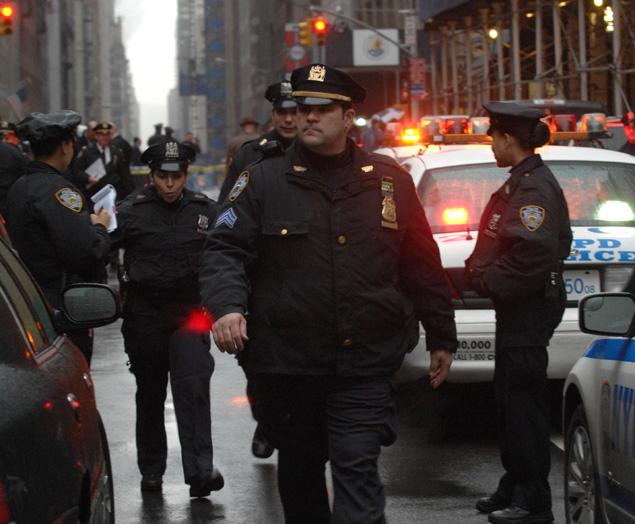
Mayor Bloomberg is term-limited, thus the city will lose its primary supporter of the Stop & Frisk policy in 2013.  Whereas many Democrats participated in the Silent March of over 10,000 people last summer, some Republicans have suggested that NYPD Commissioner Ray Kelly should run for mayor.  Such a mayoral race could easily become a referendum on police policy.

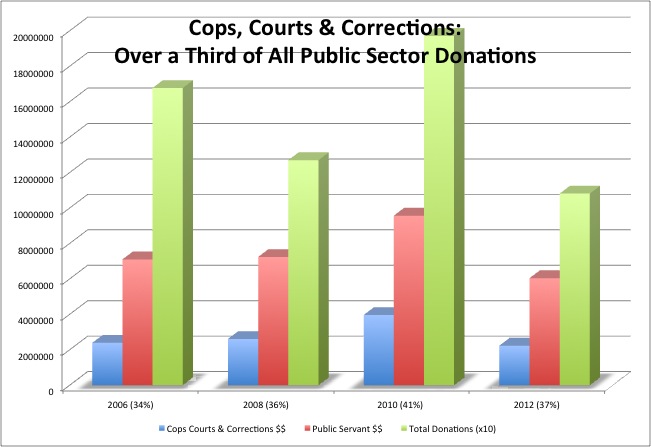
What is lesser known in politics is the increasing role of campaign dollars coming from “Cops, Courts, and Corrections (CCC).”  In New York state, seventy-three separate entities accounted for nearly half of all Public Sector donors, and provided 37% of sector dollars in 2012.  Yet this number is actually low, as it does not include the many CCC employees who are actually represented by AFSCME and other unions.  Other than political committees, the Public Sector unions are the third largest donor sector, behind Real Estate and Trial Lawyers.

Perhaps it is time to consider if CCC employees have the same economic and political interests as other members of the public sector, such as teachers.  As CCC comes to dominate this industry, it makes more sense to track them as a distinct group.  A group with an economic interest in more crimes, arrests, cases, and prisons.  The position of a union, and union solidarity, is clear where there is a product and an income.  In this situation, however, social costs and economic benefits typically support one group at the expense of others.Cops Courts Corrections Graph

Creating Safe Communities

If we set racial targeting and constitutional protections aside, the ultimate social questions are: Whether it is acceptable for nine innocent people to be harassed for every one person caught doing some form of misconduct?  Is it acceptable for twenty innocent people to be harassed for every one person caught doing something reasonably serious? Is it acceptable for ninety innocent people to be harassed for every one person caught doing something dangerous?

The answer to these questions may be “yes” for some people.  But it is an answer that should apply to one’s own community, and not be imposed on others.  For example, would the same supporters of Stop and Frisk feel the same if college dorms were targeted… especially if the “hit rate” were higher?  The current state of affairs appears to many as a massive campaign to erode stability in Communities of Color.  Distrust, despair, and hate compounds the dilemma of labeling young men with criminal records.  Families lose income, lose parents, and lose the ability to live in public housing.  One person’s plight provides little insight- we need to look at the collective impact upon millions.

This case has allowed some long-excluded voices to finally be heard, but are the police listening?  Considering one of the shooters of Amadou Diallo has been working with a badge but no gun ever since, and earned over a million dollars from the NYPD, it is challenging for urban residents to feel protected and served.  To know you are a “suspect” for simply walking down the street, the feeling is closer to being under occupation.

Posted in Courts, Police, Politics, Race | Tagged , , , , , , , , , , | Leave a comment

Part Three: Comparing the Precincts- Is Crime Reduced by Stop-and-Frisk?

As the Floyd v. New York trial continues in federal court, we hear various rationales about why the policy’s effectiveness trumps the widespread erosion (if not clear violation) of civil rights.  The primary excuse for wholesale stopping of pedestrians, frequently based on flimsy suspicion (evidenced by the low rate of uncovering criminal activity), is that it reduces crime.

Commissioner Kelly has stated that “deterrence” is the most successful outcome of the policy, even if 95% of the stops fail to generate an arrest.  State Senator Adams (retired NYPD Captain) signed a sworn affidavit in the Floyd lawsuit claiming that Kelly’s goal is to target young Black and Latino men so they will be afraid to carry weapons.  Kelly denies it.  However, 90% of the stops are of young Black and Latino men.  How this impacts all crimes, including the prevention of a few murders, requires several leaps in the chain of causation.  Furthermore, the claim that more suspects are Black and Latino is hollow.  The majority of crimes reported do not include a suspect’s race.

Statistically speaking, finding petty amounts of drugs (the most common form of “success” under Stop and Frisk) creates higher crime rates.  Yet again, with Stop and Frisk yielding so few “crimes” per area, these stats alone are not likely to drive crime rates.  Leaving aside the many factors that Mayor Bloomberg tends to ignore, let us accept the premise that police activity is driving the reduction of crime.

Two Types of Policing, and Two Types of Results

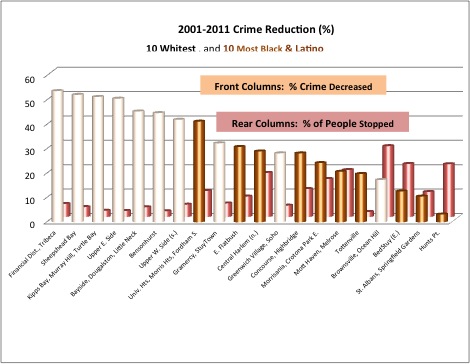
When comparing the ten precincts with the lowest percentage of Black and Latino residents vs. the ten precincts with the highest percentage of Black and Latino residents, the numbers are startling.  The White neighborhoods are being stopped on an average of 4%, and their crime is dropping 42%.  The Communities of Color are being stopped 16%, and crime is dropping 22%.

Four times the hassle, and half the results.  And it is even worse than that.  Thousands of residents in the Financial District and Tribeca, for example, hardly represent the millions of people subjected to possible stops in that district.  If police actually stopped 5% of all the people who travel through the tip of Manhattan, it would outnumber the residents of that precinct.  Meanwhile, residents in places like Hunts Point bear the entire brunt of the police activity, as tourists and workers aren’t flooding the precinct.

Aggressive Policing will stop the violence?

Detective Dean Elmore, an NYPD community outreach worker, justified the Stop-and-Frisk policy, adding that crime witnesses could do a better job.  “You have to be more specific,” Elmore said. “Be particular with your descriptions.  If you’re not particular, almost everbody’s being stopped.”  In calling it a “necessary evil,” he misleads from the fact that the majority of stops are not in response to a particular suspect being searched for.

How Accurate are NYPD’s “Reasonable Suspicions?”

The arrest and weapons yield is comparable to random motor vehicle checkpoints.   Randomly stopping vehicles was declared a 4th Amendment violation in City of Indianapolis v Edmond.  Similarly, the Supreme Court declared in Brown v. Texas (1979) that police need a reasonable suspicion to detain a pedestrian and demand identification.  Unfortunately, where fear is utilized for an expansion of police powers, the judiciary will be called upon to retain civil liberties.

Black and Latino people are more likely to be frisked, however…

By comparing the Most Frisked against the Least Frisked precincts, we look at how the police decisions to go the next level (“pat down”) has as an impact on crime.  In places where the lowest percentage of stops result in a frisk, crime reduction is far greater than in places where people are most habitually frisked.  It just so happens that the least frisked locations (Kipps Bay, Theatre District, Brooklyn Heights) are heavily populated by White residents, as opposed to the most-frisked areas.  Consider also that the crime rates are based on census data, not foot-traffic.  Thus, a place such as the Theatre District, common site of purse-snatching and shoplifting, the rates are akin to being struck by lightning.

Is this a chicken-egg situation?  Crime is going down, so police do not feel the need to frisk?  Or are they not finding crime because they are not stopping and frisking residents?  But if the police are not frisking these precincts where crime is dropping, this means (1) Forces other than Stop-and-Frisk are driving crime rates, and/or (b) Criminal activity in the White-majority neighborhoods is going undetected.  Might this mean that many of the people in these less-aggressively policed areas are actually carrying contraband and not being frisked?  It just so happens that stops of White people yield a higher percentage of contraband, indicating the NYPD profiling of White pedestrians is far higher than of Black and Latino people.

Remember also how many crimes are “possession” crimes, with no victim filing a report. The typical criminal activity being uncovered is possession of drugs, open container of alcohol, trespassing (such as on public housing), and items (other than guns) considered as weapons.

Raising children in an environment of tension

There is a social cost of nurturing our youth in neighborhoods where the public face of the government (police) is seen as an opposing force.  Youth develop into adults with arrests on their record, even when dismissed.  Adults have records for things not enforced in other parts of the country.  In Anytown, USA, people wouldn’t dream of police routinely putting kids “up against it” to check their pockets.  These different realities informs our view of what is truly going on.

At least 110 Black women and men were killed by law enforcement and security personnel over a six month period in 2012, and nine Black people killed by the NYPD.  We need to consider the direction of American race relations.  Overall, only 33% of the killings occurred in the course of police investigating actual criminal activity, while 22% were reportedly exhibiting severe mental illness, and 40 of the victims were not even alleged to have a weapon.

There are some people in power who obviously are benefitting by the criminalization of a large segment of America.  Their economic interests, or political power, is rooted in millions of people being the internal “enemy” fueling the court and prison process.  Furthermore, in a nation grossly lacking in jobs, it is useful to put a “mark” on large group of people.  Those with the mark are then barred from a moral soapbox to stand upon, to demand economic reforms that are American labor intensive, rather than purely profit driven.

We will either sink or swim together as a nation.  For 75% of American history we had two separate experiences, Black and White, in policy and in practice.  It proved to be unsustainable and combustible.  Continuing the retreat back into our past simply will not do.


Posted in Courts, Police, Race | Tagged , , , , , , , , | 1 Comment